Ratifying the Constitution
The ratification of the United States Constitution (1787-1791) sparked a fierce debate between Federalists and Anti-Federalists. Federalists, advocating for a strong central government, emphasized the weaknesses of the Articles of Confederation and the necessity for a governing framework. In contrast, Anti-Federalists opposed ratification, fearing that the absence of a Bill of Rights would empower the federal government excessively. Key states vital for ratification included Virginia and New York, whose support was crucial for the Constitution’s success, leading to the eventual establishment of the new government.

Ratifying the Constitution
E N D
Presentation Transcript
Ratifying the Constitution 1787-1791
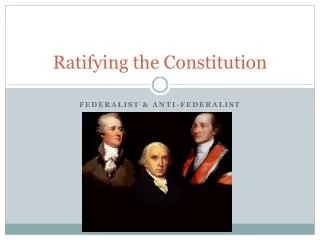
The Federalists • Supporters of Ratification (final approval) • Stressed weaknesses of the Articles • Believed in strong government
Anti-Federalists • Did NOT support ratification • Argued there was No Bill of Rights • Believed it made the Federal Gov’t too powerful • Argued that states could NOT print money, no mention of God in
9 States Ratify • 9 of 13 States needed to ratify the Const. • Framers needed New York and Virginia • Without them Gov. could not succeed.
Virginia & New York’s Ratification • With G. W’s support, he got the people of Virginia to support the constitution. • New York next after long debates • Brought number to 11.
Federalists Papers 1. 85 essays written by Framers 2. Purpose was to convince people to support constitution.
Inaugurating a New Gov’t • 1788 Ratification of the Const. • 11 of 13 states agreed. 3. R.I. and N.C. later did after Gov. was already established. • G. Washington made president on April 6, 1788, John Adams VP • Federalist video