The Ratification of the U.S. Constitution: Key Events and Perspectives
The ratification of the U.S. Constitution required the approval of 9 out of 13 states, achieved through state conventions rather than legislatures. Delaware was the first to ratify, with New Hampshire being the ninth. While Federalists advocated for a strong national government and checks and balances, Anti-Federalists argued for state power and the necessity of a national Bill of Rights. The Federalist Papers, authored by Madison, Hamilton, and Jay, played a crucial role in gaining support, especially in New York. The Constitution became effective in 1789, setting the foundation for the United States.

The Ratification of the U.S. Constitution: Key Events and Perspectives
E N D
Presentation Transcript
Ratifying Process • 9 of thirteen states need to ratify (agree) • Ratified at state conventions, not legislatures • State legs. Might fear losing power, and vote no. • Delaware is the first • New Hampshire is 9th State to ratify • NY and VA don’t agree immediately • Big, populated states • Const. would probably fail w/out them • 1789: Constitution goes into effect • NC (1788) & RI (1790) are last to ratify after disagreeing at first.
Federalists(favor Const.) • Favor a strong national government. • Argue checks and balances prevent one branch from too much power • Strong Gov needed to: • Facilitate interstate and foreign trade • National defense • Foreign relations (war, treaties) • Bill of Rights not needed: • Const. protected rights (people govern selves) • Most states already had basic bill of rights
Anti-Federalists(oppose Const.) • In favor of strong state governments. • Believe national gov would take power from states. • National Bill of Rights is necessary. • Forced Federalists to agree this would be Congress’ first task.
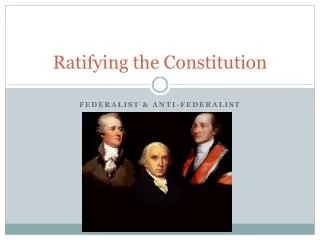
Federalist Papers • Written to win approval on Const. in NY • Authors: Publius -- J. Madison, A. Hamilton, & John Jay • Recognized as the most sophisticated explanation of American political system. • Argued: • A republic could survive in a territory as big as the USA because political factions (group) would check each others power. • National gov more important than states, but only in areas where Const. gives it power.
Why the Federalists Won • Widespread opinion that Articles of Confederation are bad. (Shay’s Rebellion) • Federalist had a plan (Const.) - Anti-Federalists had no plan. • Federalists had a national network to talk. - Anti-Feds were scattered state & local politicians • George Washington is a Federalist - He chaired the Const. Convention - Wasn’t power hungry - Everyone knew him, and knew he’d be 1st President. • Federalist Papers