Ratifying the Constitution
Explore the crucial debate surrounding the ratification of the U.S. Constitution, highlighting the primary arguments of Federalists and Antifederalists. Federalists supported a strong central government with checks and balances, while Antifederalists opposed it, fearing a monarchy-like power structure that endangered individual rights. The role of the Bill of Rights was central to this debate, as key states like Massachusetts, North Carolina, and Virginia delayed ratification until its promise. Discover how the Federalist Papers influenced public opinion and the eventual agreement to adopt the Bill of Rights.

Ratifying the Constitution
E N D
Presentation Transcript
Ratifying the Constitution 2-5 (9-13)
BIG Ideas • 1) What were the main arguments in the debate over ratification of the Constitution? • 2) What role did a bill of rights play in the debate? • 3) Which key states were among the last to ratify the constitution?
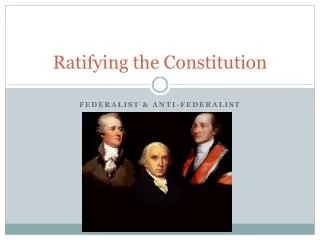
Federalists and Antifederalists • Federalists – supported a strong central government • Checks and balances would control central power • Antifederalists – opposed strong central government • too many competing interests to unify under one government • Too much like a monarchy • Danger to individual rights
Ratification Federalists Antifederalists Believed constitution already guaranteed rights Federalists Alexander Hamilton, James Madison and others drafted the Federalist Papers – “constitution guarantees enough rights” Wanted a Bill of Rights Antifederalists states Mass, NC and VA held out for a B.O.R. Federalists gave in and agreed to B.O.R. THE NATION IS BORN!