Federalists vs. Anti-Federalists: The Struggle for Constitutional Ratification and the Bill of Rights
The ratification of the U.S. Constitution marked a pivotal struggle between Federalists and Anti-Federalists. While the former promoted a strong central government, the latter feared overreach, advocating for states’ rights and a Bill of Rights. The new Constitution required only 9 out of 13 states for ratification, bypassing state power. Notable figures like Patrick Henry opposed the Constitution, warning against tyranny and advocating for individual freedoms. Ultimately, the promise of a Bill of Rights helped secure ratification, leading to the establishment of the foundational principles of American governance.

Federalists vs. Anti-Federalists: The Struggle for Constitutional Ratification and the Bill of Rights
E N D
Presentation Transcript
Ratifying the Constitution Section 5.3
Main Idea • Federalists and Antifederalists struggled over principles of the new Constitution, but the promise of adding a Bill of Rights brought about ratification.
Ratification • AoC required unanimity to amend, but the Constitutional Convention required 9 of 13. • This exceeded the power given by Congress! • Further, the state legislatures would have no say, only a special convention of citizens in each state would vote upon the ratification of the Constitution. • What shocked readers was the amount of power states were giving up to a new federal government.
Anti-Federalists • Patrick Henry, Sam Adams, and Richard Lee lead the pro-states’ rights AF. • They feared that a strong central government would trample on the rights of common men. • Most AF were from the backcountry, not the coast. • Feared that a lack of a bill of rights would lead to tyranny. • Also feared the strength of a standing military.
To the States • Del., NJ, and Pen. quickly ratify. • Geo. and Con. followed (5/9) • Mas. Was the first real test. AF lead by S. Adams put up quite a fight. • The main argument was for a bill of rights. • Narrowly Mas. ratified (6/9) • Mar., SC, and NH followed to ensure ratification (9/9). • But, with Vir. and NY missing the new nation would be weak.
Virginia • Virginia AF were lead by Henry, whose oratory skills convinced many of the evils of the Constitution. • Yet, with the 9 states already approving, Vir. couldn’t easily continue independent. Vir. ratifies (10/13).
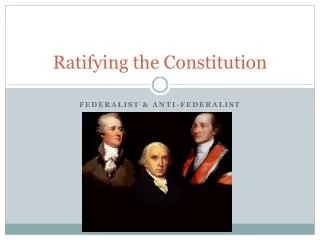
The Federalists • NY was the last major hurdle. • To convince New Yorkers Hamilton, Madison and John Jay write a series of essays that are meant to persuade readers into joining the federalist camp. • Federalist 10 attacked the idea that a republic could not work on a large nation. • NY finally relented and ratified, but sent the new Congress 32 amendments (11/13). • NC and RI only ratified after the new nation was created, not because they wanted, but they could not exist independently.
Bill of Rights • Once the Constitution was ratified, a new Congress was elected. • Their first task was to create the Bill of Rights, which was completed in 1791.