Ratifying the Constitution
The ratification of the U.S. Constitution was a contentious battle between two factions: the Federalists, who supported a strong federal government, and the Antifederalists, who feared centralized power. Key figures like Patrick Henry and James Madison led arguments on both sides, with Antifederalists insisting on a Bill of Rights to protect individual liberties. Ultimately, the Constitution was ratified after significant debate, and assurances of a Bill of Rights helped to ease unity among the states. This struggle shaped the foundation of American democracy.


Ratifying the Constitution
E N D
Presentation Transcript
Federalists vs. Antifederalists Ratifying the Constitution
The Battle for Ratification • Although the delegates the Constitutional Convention had signed the Constitution it was not yet ratified. • Nine states had to ratify the document in order for it to become the new U.S. government. • Outcome was not certain, and both sides prepared for a ratification battle in each state.
Two Sides • Supporters of the new Constitution were called Federalists. • Federalists supported a stronger federal government. • Opponents of the new Constitution were called Antifederalists. • They had a strong presence in Virginia as well as New York.
The Antifederalists • Patrick Henry of Virginia was a particularly famous Antifederalist. • Argued that the ratification of this document would make for a government with too much power. • Believed a popular government in a large nation like the U.S. would be too difficult with so many competing interests.
The Antifederalists • A popular government could only work in a smaller state. • A popular government in such a large territory would require force to hold together. • Could restrict people’s freedom. • A strong executive would be too similar to a monarch. • Which would endanger representative government and individual rights.
The Antifederalists • The Antifederalists biggest criticism of the Constitution was the lack of a bill of rights. • It would proclaim individual rights which the government could never ignore or deny. • Dangerous not to include a bill of rights because the government could too easily become tyrannical.
Federalists • The Federalists argued against these claims by citing the protection provided by the three branches. • Legislative, Judicial, and Executive would all check one another’s powers. • They believed with this system of checks and balances no single branch could become too powerful and threaten the rights of states or people.
Federalists • In reference to a bill or rights, Federalists argued that the Constitution limited the federal powers to those listed. • Any powers not listed were gaurenteed to the states or people. • Example: The Constitution did not give the power to restrict freedom of speech. • Federalists believed people had this rights and it did not need to be specifically stated.
Ratification • Despite arguments that the Constitution favored larger states, a small state was first to ratify. • December 7, 1787 Delaware voted unanimously to ratify. • The inclusion of the Senate gave them (and other small states) the confidence to ratify.
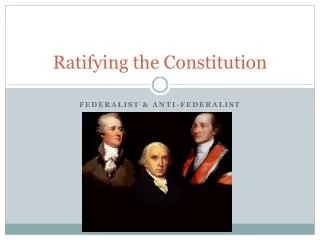
Virginia and New York were deeply split over the issue. • Were wary of the powers being given to the federal government. • Important states (size, location, and population) • Patrick Henry and James Madison of VA were leaders of the opposing sides. • James Madison-Federalist • Patrick Henry-Antifederalist
The Federalist Papers • Alexander Hamilton, James Madison, and John Jay wrote a series of 85 newspaper articles. • Known as the Federalist Papers • Intended to gain support for the Constitution. • Today, respected as an analysis of the Constitution and of the foundation of U.S. government.
Ratification • To gain time and win supporters the Federalists repeatedly delayed a vote in the New York convention. • Opposition in New York gradually weakened as other states ratified it. • Virginia and New York finally ratified it after New Hampshire became the 9th to do so on June 21, 1788.
Bill of Rights • Although the Constitution had been ratified, conventions in a number of states made recommendations that a bill of rights be added. • Massachusetts, Virginia, and North Carolina • Federalists promised thaty in the first Congress a bill of rights would be passed that covered the concerns of the states.
North Carolina ratified in Novermber 1789 • Rhode Island held out until May 1790. • Of course, the new government had already settled in at the temporary national capital of New York City. • First Congress met in New York City March 4, 1789. • George Washington is sworn in as the first national president April 30, 1789.
After observing a festival in Philidelphia celebrating the New Constitution on July 4, 1788, Dr. Benjamin Rush (a Philidelphian) wrote: • “Tis done. We have become a nation.”