Understanding Mean, Deviation, and Variance in Calorie Intake and Statistical Data
This document explores the computation of the mean for daily calorie intake based on recorded values. It also covers concepts of measures of variation, specifically the range, deviation, variance, and standard deviation. The example calculations provided illustrate how to find mean values, deviations from the mean, and their squared values. Additionally, it explains the significance of these statistical measures in understanding data dispersion and variability. Ideal for students and anyone interested in statistics and data analysis.

Understanding Mean, Deviation, and Variance in Calorie Intake and Statistical Data
E N D
Presentation Transcript
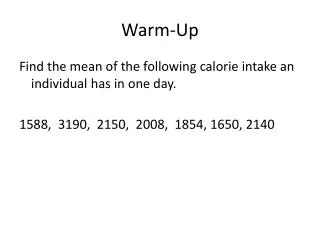
Warm-Up Find the mean of the following calorie intake an individual has in one day. 1588, 3190, 2150, 2008, 1854, 1650, 2140
Notes 2.4 (Part 1) Measures of Variation
Range • Range: is the difference from the maximum and minimum entry of a data set. It allows you to know how the data entries are dispersed. Ex 1 45 8 74 96 74 15 14 101 80 45 20 4 8
Range • Range: is the difference from the maximum and minimum entry of a data set. It allows you to know how the data entries are dispersed. Ex 1 45 8 74 96 74 15 14 101 80 45 20 4 8 Range = 101 - 4 = 97
Deviation Deviation: is the difference of a data entry to the mean of the data set. • 5 6 10 14 16 24 35 Mean = 114 = 14.25 8
5 6 10 14 16 24 35 Mean = µ = 14.25 µ = mu Values Deviations X x - µ 4 5 6 10 14 16 24 35
5 6 10 14 16 24 35 Mean = µ = 14.25 µ = mu Values Deviations X x - µ 4 -10.25 5 6 10 14 16 24 35
5 6 10 14 16 24 35 Mean = µ = 14.25 µ = mu Values Deviations X x - µ 4 -10.25 5 -9.25 6 -8.25 10 -4.25 14 -.25 16 1.75 24 9.75 35 20.75 ∑x=114 ∑ x - µ = 0
1) x - µ (deviations column) should always add up to zero 2) Deviation squared will always be positive since you are squaring the number Values Deviation Deviation Squared X x - µ (x - µ)² 4 -10.25 105.06 5 -9.25 6 -8.25 10 -4.25 14 -.25 16 1.75 24 9.75 35 20.75 ∑x=114 ∑ x - µ = 0
1) x - µ (deviations column) should always add up to zero 2) Deviation squared will always be positive since you are squaring the number Values Deviation Deviation Squared X x - µ (x - µ)² 4 -10.25 105.06 5 -9.25 85.56 6 -8.25 68.06 10 -4.25 18.06 14 -.25 0.06 16 1.75 3.06 24 9.75 95.06 35 20.75 430.56 ∑x=114 ∑ x - µ = 0 ∑ (x - µ)²= 805.48
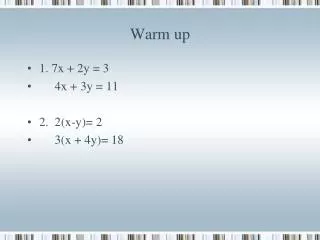
Warm-Up • 13 5 11 4 12 10 6 8 Find the values, deviation and deviations squared columns 1) Find the mean first 2) Values Deviation Deviation Squared X x - µ (x - µ)²
Values Deviation Deviation Squared X x - µ (x - µ)² 1 13 5 11 4 12 10 6 8
Mean = 70 = 7.7789 Values Deviation Deviation Squared X x - µ (x - µ)² 1 -6.778 45.941 13 5.222 27.269 5 -2.778 7.717 11 3.222 10.381 4 -3.778 14.273 12 4.222 17.825 10 2.222 4.937 6 -1.778 3.161 8 0.222 0.049 ∑ (x - µ)² = 131.553
Sample Variance Sample variance = σ² = ∑ (x - µ)² n - 1
Sample Standard Deviation Sample standard = σ = √∑ (x - µ)² deviation n - 1