Understanding Concentrations and Classifications of Matter: Collaborative Learning Activities
In this collaborative learning session, we will work through the provided packet on concentrations while completing our lab write-ups and pre-labs for the week. We will engage in direct instruction focused on measurement, solutions, and their properties. Prepare for your upcoming competency test by studying and ensuring your understanding of temperature conversions, significant figures, and types of matter. This session emphasizes the characteristics of pure substances, mixtures, solvents, and solutes through hands-on activities and engaging discussions.

Understanding Concentrations and Classifications of Matter: Collaborative Learning Activities
E N D
Presentation Transcript
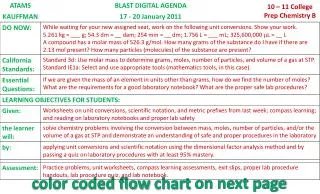
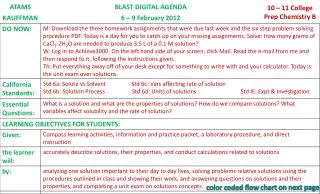
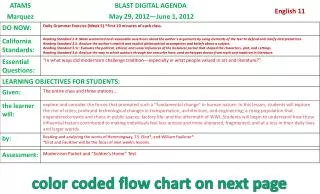
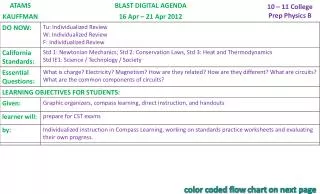
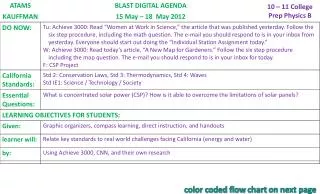
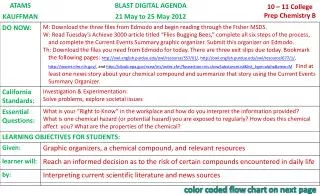
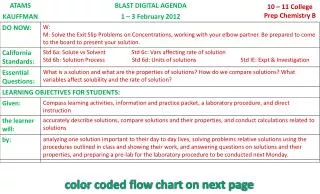
Collaborative Station: • As a group, work through the packet on Concentrations (posted on HW page). • Complete your lab write-ups and prelabsfor this week. Assignment for Monday: Pre-lab on hypothesis generation experiment Direct Instruction: • Lab and lab write-up: measurement • Solutions and their properties • Lab demonstration: hypothesis generation Assignment for Thursday: • Study for your competency test • Complete lab write-up on measurement Individual Instruction: • Compass Learning: Solutions and their properties and Concept Worksheets. • Competencies on Thursday’s test: • 1c: Temperature Conversions • 1e: Add/Subtract sig figs • 1f: Multiply/Divide sig figs • 1h: Add/Subtract in Sci Notation • 2a: ID solute/solvent • 2b: ID soluble, miscible, immiscible, insoluble • 2c: ID heterogeneous, homogeneous, alloy, solution, colloid, suspension • 2d: Classify types of matter • Retakes of incorrect competencies
Classification of Matter • Matter: anything that takes up space and has mass • Pure substance: only one type of matter is present—it is the same throughout • Element: pure substance that cannot be broken down into smaller components by non-nuclear methods • Compound: composed of two or more elements in a fixed ratio and (arrangement of atoms when it is solid) • Mixture: Two or more pure substances added together • Homogeneous: same throughout (homogenized—grind up the solid particles into small enough parts, the milk is the same throughout) • Heterogeneous: 2 different phases. • Solutions: made up of a solvent and solute. The solvent is the compound that is present in the greatest amount. The solute is the compound that is present in lesser amounts. Alloys: solution made of two or more metals.
Classification of Matter • Matter: anything that takes up space and has a resistance to a change in motion (inertia or mass) • Pure substance: something that is made up of only one type of matter. • Elements: smallest building blocks of matter that cannot be divided further without nuclear reactions • Compound: combination of 2+ elements that are arranged in a certain order by fixed ratios. • Mixture: combination of two or more pure substances that can be separated by non-chemical means. • Homogeneous mixture: the same throughout (homogenized milk: chop the fat and proteins up into small particles that can be evenly dispersed in the milk. • Solution: two or more compounds mixed uniformly throughout. The component in the largest amount is called the solvent. The component in the lesser amount is called the solute. Diet Pepsi: solvent: water; solutes: carbon dioxide, caramel color, aspartame, phosphoric acid, potassium benzoate, caffeine, citric acid, and natural flavors) • Alloy: one or more elements or compounds dissolved in a solid metal as the solvent. • Heterogeneous mixture: 2+ different regions or phases within the mixture.