Download
1 / 19
190 likes | 305 Vues
This comprehensive overview explores the structure of atoms, detailing the roles of protons, neutrons, and electrons. It explains the importance of the valence shell and introduces the Octet Rule, illustrating how atoms achieve stability. Through engaging examples like sodium and chlorine, it demonstrates how ionic bonds form as atoms exchange electrons, creating cations and anions. The text also addresses how different groups of elements interact based on their valence electrons, providing a clear foundation for understanding ionic bonding in chemistry.

E N D
Ions and Ionic bonding Chemistry 2013
What’s in an atom? (review and new Info) • Atoms are made up of 3 particles: • Protons -Located in the nucleus (center of atom) • Neutrons -Located in the nucleus (center of atom) • Electrons -Located in cloud or shells around the nucleus -Outermost shell of an atom is called the valence shell. -The number of electrons in the valence shell tells us how the atom will bond (with other atoms).
Atom drawings… • Blue are electrons. • Red are protons. • White are neutrons. • This is a drawing of… • Carbon (C).
The Octet Rule • The octet rule is… • -Atoms are most stable (content, happy, not reactive) when their valence (outermost) shells have 8 electrons. • The only elements that have eight electrons in their valence shell naturally are the noble gases.
The 8 main groups of the periodic table 1 8 7 2 4 5 6 3
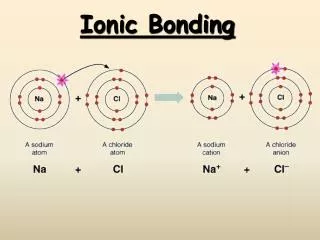
Sodium and Chlorine example: Let’s make a deal! • Sodium (Na) had 1 electron in its valence shell and chlorine (Cl) had 7 electrons in its valence shell. • They both need 8 electrons in their valence shells to be stable. • It was easier for Na to give up 1 electron than try to gain 7 electrons. • It was easier for Cl to gain 1 electron than try to lose 7 electrons. • So, sodium gave up its 1 electron. The shell below the valence shell already has an octet (8 electrons). Therefore, sodium is now stable. • Cl gained 1 electron, so it now has 8 electrons in its valence shell, which makes it stable.
Sodium (Group 1) and Chlorine (Group 7) 8 1 3 6 7 4 5 2
Forming the bond • Sodium loses 1 electron so it has one less electron than Neon (Ne). Protons have a positive (+) charge so the Na will have an overall +1 charge because it lost 1 negatively charged electron. • This Sodium atom will now be a cation. (Positively charged ion). Na+ • Chlorine gains one electron so it has one more electron than Argon (Ar). Electrons have a negative (-) charge so the Cl atom will have an overall -1 charge because it gained 1 negatively charged electron. • This Chlorine atom will now be an anion (Negatively-charged ion). Cl-
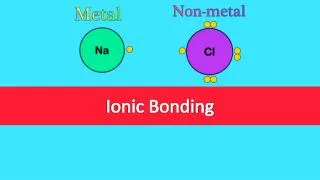
Sodium and Chlorine example: Let’s make a deal! • (Let’s draw out what happened when Na and Cl formed an ionic bond…) • Na: 1 valence electron Cl: 7 valence electrons • is shown by 1 dot are shown by 7 dots
Sodium and Chlorine example: Let’s make a deal! • (Let’s draw out what happened when Na and Cl formed an ionic bond…) • When they form an ionic bond and exchange electrons, Na loses 1 electron and Cl gains that 1 electron. Now both have 8 in their valence shells (Na had 8 electrons in its next lowest shell)
Which elements like to gain or lose electrons? • Metals (Groups 1-3) have less than 4 electrons in their valence shells. They would rather lose electrons to form cations. • Nonmetals (Groups 5-7) have more than 4 electrons in their valence shells. They would rather gain electrons to form anions.
Groups 1-3 want to lose Electrons 8 1 3 6 7 4 5 2
Groups 5-7 want to Gain Electrons 8 1 3 6 7 4 5 2
Group 8 is happy how it is (already has a full 8 (Octet)) 8 1 3 6 7 4 5 2
Group 4 can go either way (Gain or lose) depending on the atom… 8 1 3 6 7 4 5 2
More examples • K and F • -K (Potassium) is in group 1 so it has 1 valence electron. • -F (Flourine) is in group 7 so it has 7 valence electrons. • -Which atom will… • -lose electrons? _______ How many?________ • -gain electrons? _______ How many?_______ • Which atom becomes a(n)… • -Cation?___________ • -Anion? ____________ K 1 1 F K+ F-
More examples • Ca and S • -Ca (Calcium) is in group 2 so it has 2valence electron. • -S (Sulfur) is in group 6 so it has 6valence electrons. • -Which atom will… • -lose electrons? _______ How many?________ • -gain electrons? _______ How many?_______ • Which atom becomes a(n)… • -Cation?___________ • -Anion? ____________ Ca 2 2 S Ca2+ S2-
Your turn – Turn this page in!Your name here:________________ • Al and N • -Al (Aluminum) is in group _____ so it has _____ valence electrons. • -N (Nitrogen) is in group ____ so it has ______ valence electrons. • -Which atom will… • -lose electrons? _______ How many?________ • -gain electrons? _______ How many?_______ • Which atom becomes a(n)… • -Cation?___________ • -Anion? ____________