Understanding Parallelograms: Criteria and Proofs in Quadrilaterals
170 likes | 284 Vues
In this lesson, we explore how to determine whether a quadrilateral is a parallelogram using various theorems. Key criteria include: if the diagonals bisect each other, if one pair of opposite sides is both congruent and parallel, if both pairs of opposite sides are congruent, and if both pairs of opposite angles are congruent. We will connect these concepts to real-world applications, including architectural designs by Frank Lloyd Wright. Additionally, we'll solve for missing variable values to confirm the classification of quadrilaterals as parallelograms.


Understanding Parallelograms: Criteria and Proofs in Quadrilaterals
E N D
Presentation Transcript
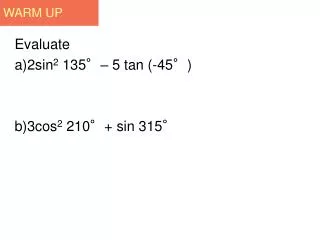
Warm up 6.3 CSYN Page 303
6-3 Proving That a Quadrilateral is a Parallelogram page 303 Objective: To determine whether a quadrilateral is a parallelogram
And why…. • To use a parallel rule to plot a ship’s course, as in Example 3
Real World Connection Frank Lloyd Wright, a famous architect, used parallelograms in designs of many houses, such as the Kraus House in Kirkwood, Missouri.
Theorem 6-5 (converse of Th. 6-3) If the diagonals of a quadrilateral bisect each other, then the quadrilateral is a parallelogram. B C A D
Theorem 6-6 If one pair of opposite sides of a quadrilateral is both congruent and parallel, then the quadrilateral is a parallelogram.
Theorem 6-7 If both pairs of opposite sides of a quadrilateral are congruent, then the quadrilateral is a parallelogram.
Theorem 6-8 If both pairs of opposite angles of a quadrilateral are congruent, then the quadrilateral is a parallelogram. B C A D
10x – 24 = 8x + 12 Diagonals of parallelograms 2y – 80 = y + 9 bisect each other. 2x – 24 = 12 y – 80 = 9 Collect the variable terms on one side. y = 89 2x = 36 Solve. x = 18 Proving that a Quadrilateral Is a Parallelogram Find values of x and y for which ABCD must be a parallelogram. If the diagonals of quadrilateral ABCD bisect each other, then ABCD is a parallelogram by Theorem 6-5. Write and solve two equations to find values of x and y for which the diagonals bisect each other. If x = 18 and y = 89, then ABCD is a parallelogram. 6-3
Another one… • Solve for x in which ABCD must be a parallelogram C B 4x - 5 3x D A
You try one… • Turn to page 305 and complete check understanding 1 (top of page).
Proving that a Quadrilateral Is a Parallelogram Determine whether the quadrilateral is a parallelogram. Explain. a. All you know about the quadrilateral is that only one pair of opposite sides is congruent. a. Therefore, you cannot conclude that the quadrilateral is a parallelogram. b. b. The sum of the measures of the angles of a polygon is (n – 2)180, where n represents the number of sides, so the sum of the measures of the angles of a quadrilateral is (4 – 2)180 = 360. If x represents the measure of the unmarked angle, x + 75 + 105 + 75 = 360, so x = 105. Theorem 6-8 states If both pairs of opposite angles of a quadrilateral are congruent, then the quadrilateral is a parallelogram. Because both pairs of opposite angles are congruent, the quadrilateral is a parallelogram by Theorem 6-8. 6-3
You try one… • Turn to page 306 and complete check understanding 2 (top of page)
Another one… • Determine if the quadrilateral must be a parallelogram. Explain. Yes, both pairs of opp. Sides are congruent
Proving that a Quadrilateral Is a Parallelogram The captain of a fishing boat plots a course toward a school of bluefish. One side of a parallel rule connects the boat with the school of bluefish. The other side makes a 36° angle north of due east on the chart’s compass. Explain how the captain knows in which direction to sail to reach the bluefish. Because both sections of the rulers and the crossbars are congruent, the rulers and crossbars form a parallelogram. Therefore, the angle shown on the chart’s compass is congruent to the angle the boat should travel, which is 36° north of due east. 6-3
Summary State 4 different ways you can show a quadrilateral is a parallelogram. 1. If the diagonals of a quadrilateral bisect each other, then the quadrilateral is a parallelogram 2. If one pair of opposite sides of a quadrilateral is both congruent and parallel, then the quadrilateral is a parallelogram. 3. If both pairs of opposite sides of a quadrilateral are congruent, then the quadrilateral is a parallelogram. 4. If both pairs of opposite angles of a quadrilateral are congruent, then the quadrilateral is a parallelogram.
Assignment 6.3 Page 307 #1-29 (omit 17),