Understanding and Measuring Angles: A Comprehensive Guide
This resource provides a thorough introduction to angles, including definitions, classification, and measurement techniques. Students will learn how to use a protractor to measure angles accurately and classify them as acute, right, obtuse, or straight. The document includes the angle addition postulate and examples of naming angles in different ways. Engage with practical exercises to reinforce understanding and apply concepts effectively. Enhance your geometry skills while mastering angle measures in various geometric figures.

Understanding and Measuring Angles: A Comprehensive Guide
E N D
Presentation Transcript
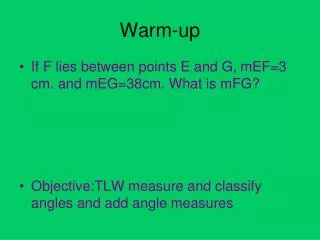
Warm-up • If F lies between points E and G, mEF=3 cm. and mEG=38cm. What is mFG? • Objective:TLW measure and classify angles and add angle measures
1.5: Measuring Angles Obj: Use a protractor to measure angles and name angles.
Other Geometric Figures • Angle: a figure formed by 2 rays with a common endpoint. • Vertex of the angle: The common endpoint • Sides of the angle: the rays
Ex: Identify the vertex of the angle below and name its sides. Vertex__________ Sides ________ ----------- A R C
Angles • Naming an angle (3 ways) • < with the name of the vertex • < with a point from one side, the vertex, and a point from the other side • < with a number shown in the interior
Example B G 3 L Possible Names H
Using a Protractor to Measure Angles • Line arrow of protractor with vertex of angle • Place edge of protractor on one ray of angle • Determine which #’s to use (ray is on 0) • Find degree measure where other ray intersects the protractor
Definitions • Congruent Angles: Angles with the same degree measure • Ex: • Note: To indicate that angles are congruent in a pic use arcs on the angles 80° 80°
Types of Angles • Acute: 0-90 degrees • Right: 90 degrees • Obtuse: 90-180 degrees • Straight: 180 degrees
Angle Addition Postulate • If point S is in the interior of < PQR, then m < PQS + m < SQR = m < PQR R Q S P