Understanding Logarithms: Properties, Evaluations, and Change of Base Method
This resource delves into the fundamental concepts of logarithms and their properties, showcasing how logarithmic and exponential functions serve as inverses. It outlines examples of switching between logarithmic and exponential forms, along with practical exercises for learners to practice their skills. Special focus is given to natural logarithms (ln) and how to utilize the change of base formula for evaluating logs of various bases with calculators. Engage in group discussions and solve problems to reinforce your understanding of logs and their applications.

Understanding Logarithms: Properties, Evaluations, and Change of Base Method
E N D
Presentation Transcript
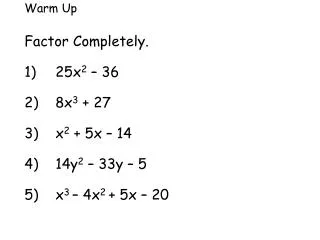
Warm Up Factor Completely. 25x2 – 36 8x3+ 27 x2 + 5x – 14 14y2 – 33y – 5 x3 – 4x2 + 5x – 20
Logarithms… Log functions and exponential functions are inverses… If f(x) = bx,then f-1(x) = logbx
Logarithmic Form Exponential Form Lots of examples of switching forms…
Talk to your group… • If 101.681 = 48, what is log 48 ? _____ • If log 156 = 2.193, what is 102.193 ? __
Your Turn… Log864 = ____ Log464 = ____ Log264 = ____ Log6464 = ____ Log81 = ____ Log8 (1/64) = ____
If 52.892 = 105, then log5105 = ____ • If log217 = 4.088, what is 24.088 ? • log5(54) = ____ • = ____
Ln (read “Natural Log”) is a special log with a base e. Basic Log Properties: • ln 1 and log 1 = _____ • lne = _____ • logbb = _____ • elnx = _____ • _____
Examples: Use the properties of logs to expand. Write as a single log(condense):
Change of Base • Since our calculators can only evaluate a base of 10 or e, we will let a = 10 or use ln. • This formula allows us to evaluate logs with ANY base using the calculator!
Examples Evaluate using change of base: