Download
1 / 7
70 likes | 155 Vues
Learn when to use "el" or "la" for definite articles and "un" or "una" for indefinite articles in Spanish sentences. Practice word order, adjective placement, and forming coherent sentences. Strengthen your grasp on article usage.

E N D
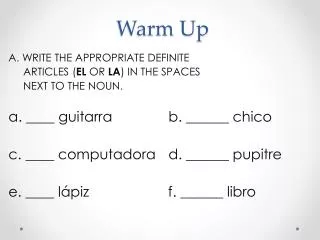
Warm Up A. WRITE THE APPROPRIATE DEFINITE ARTICLES (EL OR LA) IN THE SPACES NEXT TO THE NOUN. a. ____ guitarra b. ______ chico c. ____ computadora d. ______ pupitre e. ____ lápiz f. ______ libro
Word order: Placement of adjectives • In spanish, adjectives usually come after the noun they describe. Notice how deportista follows chico in the Spanish sentence. Ejemplo: Luis es un chicodeportista. Luis is a sport-minded boy.
Important • In English, the adjective comes before the noun. • This is a simple pattern you can follow when writing a sentence in Spanish.
Practica Put the following words in order to form a sentence: • chica / artística / una / soy • un / soy / inteligente / chico • Simpática / una / Alicia / es / chica • el Sr. Ortega / bueno / es / profesor / un • estudiante / soy / trabajador / un • estudiosa / una / Martha / chica / es • soy / según / talentoso / amigos / muy / mis
Práctica • Página 62 – actividad 19 * Keep in mind that if we are using a title (like señor or doctor) to start a sentence, we need to use a definite article before the title (el, la).
Haga ahora B. Use the correct indefinite article: • ___ pupitre • ___ lápiz • ___ chico • ___ guitarra • ___ computadora C. Review definite and indefinite articles for a quiz.
Haga ahora Use each correct indefinte article: • _____ día • _____ estudiante • _____ profesor • _____ clase • _____ mano • _____ pie • _____ dedo • _____ cabeza