Understanding Graph Features: Domain, Range, and Function Behavior
This lesson focuses on identifying key features of functions, specifically through the analysis of graphs. Students will learn to find x-intercepts and y-intercepts, as well as determine if functions are increasing or decreasing. We will explore intervals where functions are positive or negative, and how to identify extrema (relative minimums and maximums). Additionally, the concepts of domain and range will be clarified, along with a discussion on asymptotes. Practical examples will guide students in applying these concepts in real-world scenarios.

Understanding Graph Features: Domain, Range, and Function Behavior
E N D
Presentation Transcript
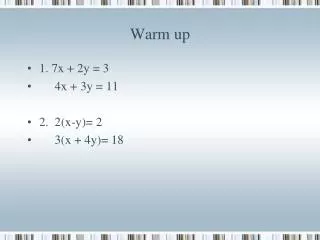
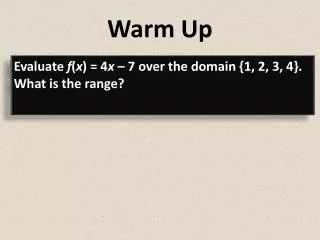
Warm Up Evaluate f(x) = 4x – 7 over the domain {1, 2, 3, 4}. What is the range?
How do we interpret and represent functions? F.IF.6Functions Lesson 3:Identifying key features of a graph
Identifying Key Features of a Graph Intercepts: X-intercept: The place on the x-axis where the graph crosses the axis
Example 1 Identify the x-intercepts:
Example 2 Identify the x-intercepts:
Example 3 Identify the x-intercepts:
Identifying Key Features of a Graph Intercepts: y-intercept: The place on the y-axis where the graph crosses the axis
Example 1 Identify the y-intercepts:
Example 2 Identify the y-intercepts:
Example 3 Identify the y-intercepts:
Identifying Key Features of a Graph 1. Intercepts: Find the x and y intercepts of the following graph. ?
Identifying Key Features of a Graph Increasing or Decreasing???? Increasing: A function is said to increase if while the values for x increase as well as the values for y increase. (Both x and y increase)
Identifying Key Features of a Graph Increasing or Decreasing???? Decreasing: A function is said to decrease if one of the variables increases while the other variable decreases. (Ex: x increases, but y decreases)
Example 1 Increasing or decreasing?
Example 2 Increasing or decreasing?
Identifying Key Features of a Graph Intervals: An interval is a continuous series of values. (Continuous means “having no breaks.)
Identifying Key Features of a Graph Intervals: • A function is positive when its graph is above the x-axis. • The function is negative when its graph is below the x-axis.
Identifying Key Features of a Graph The function is positive when x > ? When x > 4!
Example 1 Part 1 The function is positive when x _ __?
Example 1 Part 2 The function is negative when x _ __ ?
Example 2 Part 1 The function is positive when x _ __ ?
Example 2 Part 2 The function is negative when x _ __ ?
Identifying Key Features of a Graph Extrema: • A relative minimum is the point that is the lowest, or the y-value that is the least for a particular interval of a function. • A relative maximum is the point that is the highest, or the y-value that is the greatest for a particular interval of a function. • Linear and exponential functions will only have a relative minimum or maximum if the domain is restricted
Identifying Key Features of a Graph Domain and Range: Domain: all possible input values Range: all possible output values
Remember your numbers when describing domain and range… Natural numbers: 1, 2, 3, ... Whole numbers: 0, 1, 2, 3, ... Integers: ..., –3, –2, –1, 0, 1, 2, 3, ... Rational numbers: numbers that can be written as a fraction, terminating decimal or repeating decimal Irrational numbers: numbers that cannot be written as a fraction, terminating decimal or repeating decimal Real numbers: the set of all rational and irrational numbers
Example 1 What is the domain? Range?
Example 2 What is the domain? Range?
Identifying Key Features of a Graph Asymptotes: A line that the graph gets closer and closer to, but never crosses or touches.
Example 1 Identify the asymptote:
Example 2 Identify the asymptote:
Identifying Key Features of a Graph Identify the following: Type of function Domain and Range Increasing or Decreasing Extrema Guided Practice Example 1 • A taxi company in Atlanta charges $2.75 per ride plus $1.50 for every mile driven. Determine the key features of this function.
Identifying Key Features of a Graph Guided Practice Example 2: • Identify the following: • Type of function • Domain and range • Increasing or decreasing • Asymptote