Converting Between Polar and Rectangular Coordinates: Graphing Without a Calculator
This guide covers essential concepts in converting between polar and rectangular forms, including direct conversions of coordinates and equations. You will learn how to transform rectangular points to polar form and vice versa. Moreover, it explains how to graph polar equations like r = a ± b cos(θ) and r = a ± b sin(θ) without using a calculator, as well as identifying the conditions that produce cardioids versus limaçons. Master these conversions and graphing techniques to enhance your understanding of polar coordinates.

Converting Between Polar and Rectangular Coordinates: Graphing Without a Calculator
E N D
Presentation Transcript
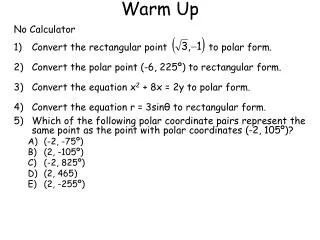
Warm Up No Calculator • Convert the rectangular point to polar form. • Convert the polar point (-6, 225º) to rectangular form. • Convert the equation x2 + 8x = 2y to polar form. • Convert the equation r = 3sinθ to rectangular form. • Which of the following polar coordinate pairs represent the same point as the point with polar coordinates (-2, 105º)? • (-2, -75º) • (2, -105º) • (-2, 825º) • (2, 465) • (2, -255º)
Use your Polar Graphs Investigation Homework…(#s1 – 4) a) r = a b) r = acos θ c) r = asin θ Generalizations that will help you graph each without a calculator: Without a calculator, graph the following. 1) r = -6sinθ 2) r = 5
Use your Polar Graphs Investigation Homework…(#8-11 ) r = a b cos θ OR r = a b sin θWhat will make these graphs cardioids instead of a limaçons?
Use your Polar Graphs Investigation Homework…(#5-7 ) r = acos(nθ) OR r = asin(nθ) These are called “rose curves” If n is an odd number, generalizations that will help you graph without a calculator… If n is an even number, generalizations that will help you graph without a calculator…