Understanding Deliberative Arguments: Elements, Applications, and Societal Impact
This piece explores the concept of deliberative arguments, offering a detailed definition and outlining its key elements. A deliberative argument is structured to persuade or dissuade a decision maker or public audience regarding a specific course of action. Key components include the thesis statement, audience consideration, and the use of confirmation and refutation questions. Through the lens of societal issues like abortion, as discussed in "Freakonomics," it illustrates how rhetoric can sway public opinion and inform decisions with statistical evidence and examples.

Understanding Deliberative Arguments: Elements, Applications, and Societal Impact
E N D
Presentation Transcript
Megan, Maiah, and Jefferson Deliberative Argument
Essential Question • What is a deliberative argument and what are its elements? How is it used?
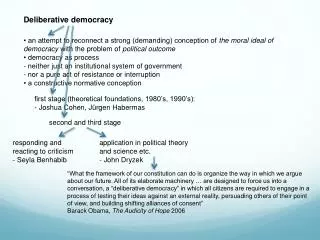
Definition of Deliberative • “Deliberative is an argument given to a decision maker or a public audience seeking advice to take or not take a course of action.”
Elements of Deliberative • Audience • Decision Maker • Public seeking advice • Thesis Statement • Helps the audience understand the argument • Persuasion/Dissuasion • Sways the audience opinion • Confirmation Questions • Supporting a course of action • Refutation Questions • Denouncing a course of action • Opposites (Confirmation/Refutation) • Easy/Hard • Possible/Impossible • Lawful/Unlawful • Correct/Incorrect
Deliberative in Freakonomics • Thesis • How does abortion affect society? • Persuades • Give statistics to convince the audience • Confirmation (Supports Abortion) • Cuts crime • Cuts abuse • Refutation (Against Prohibiting Abortion) • Romania-Chaos • Roe vs. Wade led to the drop in crime • Gives an audience advice • Showcases examples • Opposites • Less crime/chaos • Pro Choice/Pro Life
Review • Deliberative is an argument given to a public audience or a decision maker to persuade/dissuade them to take a course of action. The thesis statement shows whether the argument maker confirms or refutes the argument using opposites.
Assessment • Discuss how the following video displays the elements of deliberative argument. Use specific examples.
Elements of Deliberative • Audience • Decision Maker • Public seeking advice • Thesis Statement • Helps the audience understand the argument • Persuasion/Dissuasion • Sways the audience opinion • Confirmation Questions • Supporting a course of action • Refutation Questions • Denouncing a course of action • Opposites (Confirmation/Refutation) • Easy/Hard • Possible/Impossible • Lawful/Unlawful • Correct/Incorrect
Standards and Benchmarks • SSS: • LA.910.6.3.2 • LA.910.5.2.5 • LA.910.6.3.3 • LA.910.5.2.1 • AP: • Analyze and interpret samples of good writing, identifying and explaining an author’s use of rhetorical strategies and techniques • Demonstrate understanding of the conventions of citing primary and secondary sources • Create and sustain arguments based on readings, research and/or personal experience