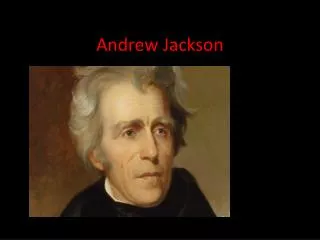
Andrew Jackson: From Orphaned Youth to President and War Hero
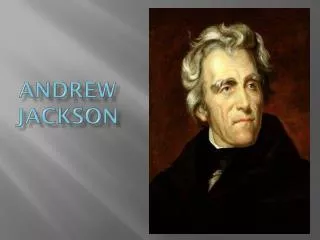
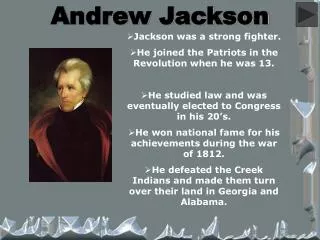
Explore the remarkable life of Andrew Jackson, born on the NC/SC border, who faced hardships during the Revolutionary War, including being orphaned and captured. Rising from a self-made man, he became a prominent lawyer and judge in Tennessee. His military prowess in the War of 1812 led to fame as "Old Hickory." Jackson transformed American politics as the first "Common-Man President," enacted the Indian Removal Act, and opposed the National Bank. His presidency marked significant political shifts, including greater democracy and the controversial spoils system.

Andrew Jackson: From Orphaned Youth to President and War Hero
E N D
Presentation Transcript
Early Life Born on NC/SC border – at various times will claim origin from NC, SC, and TN.
Revolutionary War • Joins local militia as courier at age 13. • Eldest brother, Hugh, dies in battle. • Jackson and brother Robert are captured by British. • Struggles: starvation, small pox, cholera – then orphaned • Struck by sword of British officer after refusing to clean officer’s boots.
Self-Made Man • Teaches school for one year in NC. • Moves to TN to practice law. Due to background, prospers based on merits – Frontier law. After several years, becomes Judge. • Uses funds to purchase plantation known as The Hermitage – becomes successful planter. Primary crop: Cotton.
War Hero • “Old Hickory” • War of 1812 • Battle of Horseshoe Bend • Battle of New Orleans • Seminole War • Adams-Onis Treaty
Politics • Loses Presidential Election of 1824 • Corrupt Bargain • Victorious in Election of 1828 • Higher Voter Turnout: less restrictive requirements • Common-Man President • First Western President • Re-elected in 1832 • First use of National Convention
Jackson’s Presidency • Creation of Spoils System • Greater Democracy • “The Great Silence”
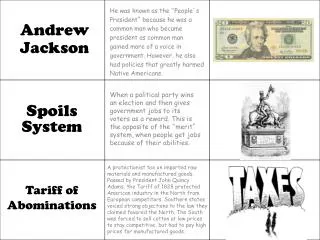
Nullification Crisis • Debate over high tariffs • Tariff of Abominations • John C. Calhoun • Theory of nullification • Calhoun’s “S.C. Exposition and Protest” S.C. threatens secession • Jackson threatens the use of force • Henry Clay organizes a compromise
Indian Policies • Different views about Indian policy • Indian Removal Act, 1830 • Cherokee takes the issue to the Supreme Court and wins • Worchester v. Georgia • Jackson ignores the court and orders removal • Trail of Tears, 1838
National Bank • Jackson disliked the Bank of the U.S. • Thought it an abuse of power and served the wealthy first • Thought it lacked the constitutional ability to exist • Jackson vetoed the new charter for the bank and withdrew all gov’t funds • “Pet Banks”