Human Population Growth
160 likes | 261 Vues
This chapter discusses the primary factors affecting human population growth, including births, deaths, and migration. It examines how immigration and emigration influence population change, leading to concepts like zero population growth (ZPG). The chapter also focuses on fertility rates, including replacement fertility and total fertility rates (TFR), highlighting the impact of various social and economic factors. Key influences such as urbanization, children in the workforce, and access to family planning are analyzed, providing insight into trends in population dynamics over time.


Human Population Growth
E N D
Presentation Transcript
Human Population Growth Miller Chapter 11-1
Factors affecting population size • Populations grow or decline through the interplay of three factors • Births • Deaths • Migration • Immigration • Emigration
Migration • Emigration – moving away from a population • Begins with “E” like exit • Immigration – moving into a population • Begins with “I” like into
Population change • Population change = (Births + immigration) – (Deaths + emigration) When these balance – ZPG (Zero population growth)
Birth and death rates • Calculated as the number of births or deaths per 1000 people in a population in a given year.
Fertility Rates • Replacement fertility – number of children needed to replace themselves 2.1 to 2.5 per couple.
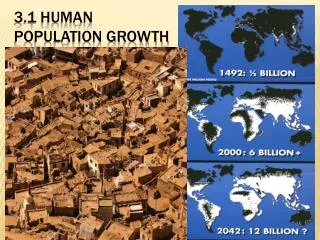
Total Fertility Rate (TFR) • Estimate of average number of children a woman will have between ages 15-49 • Current world value of 2.9 would result in a world population of 296 billion in 150 years
Fertility Rates US • US population has increased from 76 million in 1900 to over 276 million. • Our fertility rates have dropped since 1950, but we continue to grow very rapidly.
Factors that affect Birth and Fertility rates • Importance of children in the workforce • Urbanization • Cost of raising and educating children • Educational and employment opportunities for women • Increases • Decreases – access to family planning • Decreases • Decreases
Infant mortality rate • Average age of marriage or first child • Availability of legal abortions • Increases with increasing mortality • Increases with lower age • decreases
Availability of reliable birth control • Religious beliefs, traditions, and cultural norms • Decreases • Increases in countries where large families are encouraged