Understanding Transformers: Energy Transfer and Efficiency Explained
This informative piece explores transformers, devices designed to transfer energy between electrical circuits. It outlines the four main principles governing transformer operation, including voltage and current changes depending on the number of primary (Np) and secondary (Ns) turns. The importance of efficiency in energy transfer is discussed, with real-world examples such as power plants and home applications to illustrate how transformers step up or step down voltage for optimal power delivery. Gain insights into three-phase transformers and the benefits they offer for power generation and distribution.

Understanding Transformers: Energy Transfer and Efficiency Explained
E N D
Presentation Transcript
Transformers • By Stephen, Victor, Thomas and Tim
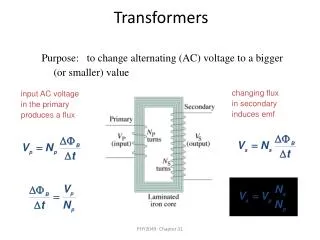
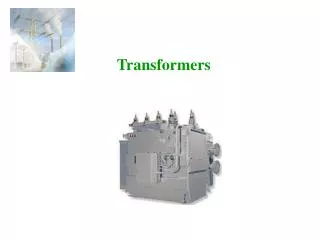
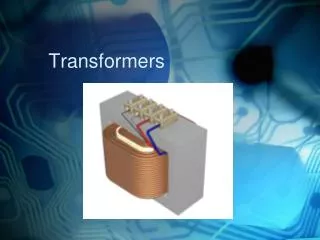
What Is a Transformer? A device designed to transfer energy from one electrical circuit to another.
How Does It Work? Four Main Principles
If Np (number of primary turns) = Ns (number of secondary turns), then no change in voltage or current. • If Np > Ns, voltage is decreased and current is increased. • If Np < Ns, voltage is increased and current is decreased. • If Np = Ns, then energy is simply transferred and no changes take place. • Remember that: Vs/Vp = Ip/Is = Ns/Np • However, it’s not so simple…
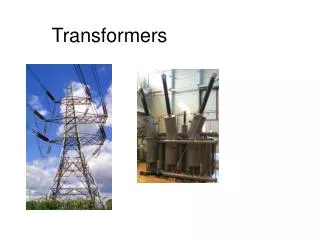
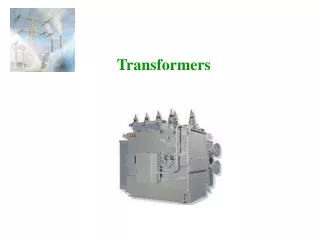
Real World Examples – Power Plants • Power plants step up voltage to tens of thousands of volts for efficient transfer (high voltage means low current, which means lower resistance). • Voltage is stepped down using a series of sub-stations, by the time it reaches your house it is at 120v. • Power meters often use an isolation transformer that is 1:1, in order to protect the house from interference from the main line, and visa versa. • Power generators are often three-phased; they have windings places 120 degrees apart. A three-phased transformer consisting of three coils is required to match this. • Advantage is up to 173% more power, because power is available between any two of the three phases
A Demonstration By.. Thomas