

SlideServe
Menu
Préférences
© SlideServe · v2026

Transformers

laird avatar
23 diapositives · 797 Views · Jul 13, 2012

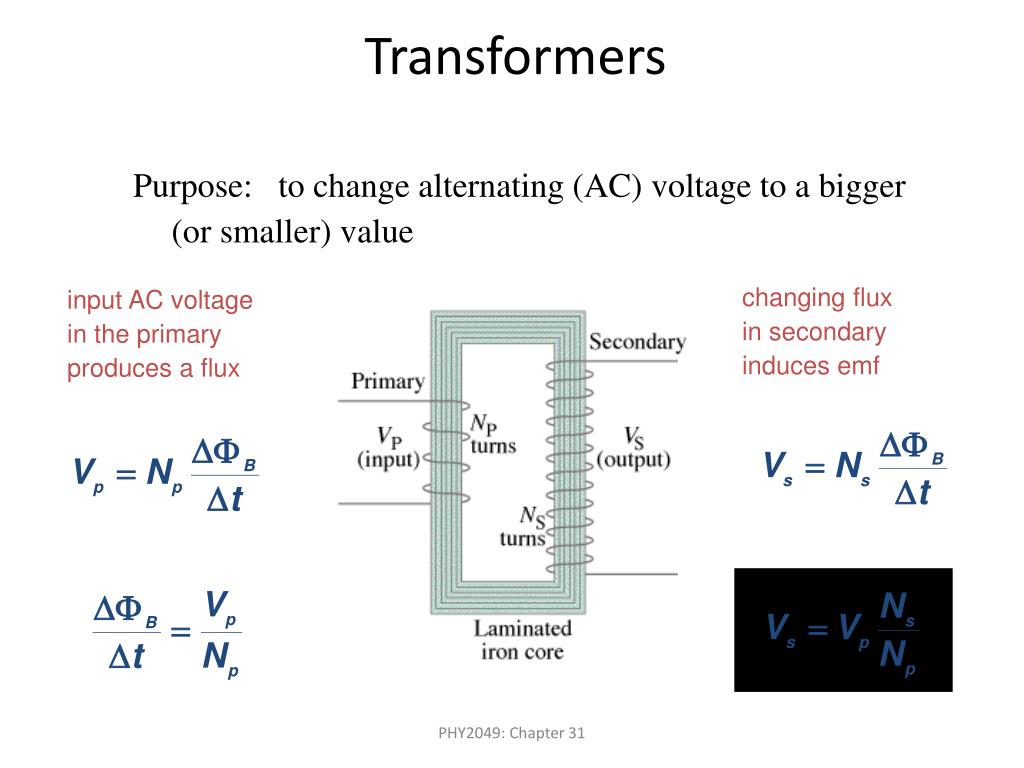
Transformers. Purpose: to change alternating (AC) voltage to a bigger (or smaller) value. changing flux in secondary induces emf. input AC voltage in the primary produces a flux. Principle of Transformer Action. Principle of Transformer Action. Principal of Transformer Action
Transformers - slide 1
01 / 23Transformers
1 / 17

Télécharger la présentation

Transformers
Une image / un lien ci-dessous est fourni (tel quel) pour télécharger la présentation

Politique de téléchargement : le contenu du site vous est fourni TEL QUEL pour votre information et votre usage personnel ; il ne peut être vendu, concédé sous licence ni partagé sur d’autres sites sans l’accord de son auteur.Le contenu vous est fourni TEL QUEL, pour votre information et votre usage personnel uniquement. Téléchargez la présentation en cliquant sur ce lien. Lors du téléchargement, si vous ne parvenez pas à télécharger une présentation, l’éditeur a peut-être supprimé le fichier de son serveur.Pendant le téléchargement, si vous ne parvenez pas à obtenir une présentation, le fichier a peut-être été supprimé par l’éditeur.

F I N

Plus de contenu associé

Transcription de la présentation
  1. Transformers Purpose: to change alternating (AC) voltage to a bigger (or smaller) value changing flux in secondary induces emf input AC voltage in the primary produces a flux PHY2049: Chapter 31

  2. Principle of Transformer Action

  3. Principle of Transformer Action • Principal of Transformer Action • Principle of electromagnetic induction. • Ideal tωo ωinding transformer • ωinding resistances are negligible • Fluxes confined to magnetic core • Core lose negligible • Core has constant permeability • V1 I1 MMF = N1Ie • Core flux φ folloωs, Ievery closely. • Ie & φ sinusoidal • φ =φmax sinωt

  4. Principle of Transformer Action

  5. Transformers • Nothing comes for free, however! • Increase in voltage comes at the cost of current. • Output power cannot exceed input power! • power in = power out

  6. Transformers: Sample Problem • A transformer has 330 primary turns and 1240 secondary turns. The input voltage is 120 V and the output current is 15.0 A. What is the output voltage and input current? step-up transformer

  7. Ideal Transformer on an inductive load

  8. The exciting current leads the flux by hysteretic angle,

  9. Transformer on LOAD

  10. Equivalent circuit referred to the LT side of a 250/2500 single phase transformer is shown in fig. The load impedance connected to HT is 380+j230Ω. For a primary voltage of 250V, compute • the secondary terminal voltage • primary current and power factor • Power output and efficiency

  11. Equivalent circuit referred to the LT side of a 250/2500 single phase transformer is shown in fig. The load impedance connected to HT is 380+j230Ω. For a primary voltage of 250V, compute • the secondary terminal voltage • primary current and power factor • Power output and efficiency • Z'L = (380+j230) (N1 / N2)2 • = (380+j230) (250/2500)2 • = 3.8+j2.3 • Total impedance in the primary Secondary terminal voltage = I2ZL

  12. Im= V1/jXm = 250∟0°/250∟90° =1∟-90° =0-j1 I'e = Ic + Im = 0.5+ (0-j1) = 0.5-j1 I'1= I'1 +I‘e = 40- j30+0.5- j1= 51∟-37.4° b) Primary current I1 = 51A Primary p.f = cosθ1 = cos37.4° = 0.794 lagging (c) Load p.f • cosθ2 = 380°/ (3802+2302 )= 0.855 • Power Output = V2I2cosθ2 = 2220*5*0.855 = 9500 Watts • Power Output = I'12RL = 502*3.8 = 9500 Watt • Core Loss ,PC= v12 / RC = Ic2 RC = 0.52*0.2 =500 Watts • Power Input = V1I1cosθ1 = 250*51*0.794 = 10123.5