Exploring the Theme of Torture in Orwell's Work: An Insightful Analysis
In Chapter 1 of Book III, the theme of torture is introduced, highlighting its implications on society and individual psyche. George Orwell communicates this idea through vivid imagery and emotional resonance, illustrating the psychological effects of oppression. Through examples, we see how characters respond to their suffering and how such experiences reveal the brutality of totalitarian regimes. This exploration invites readers to reflect on the moral complexities surrounding torture and whether such practices can ever be justified.

Exploring the Theme of Torture in Orwell's Work: An Insightful Analysis
E N D
Presentation Transcript
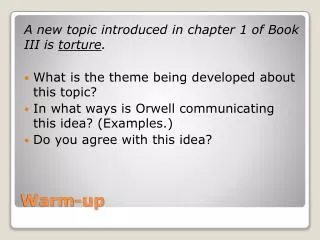
A new topic introduced in chapter 1 of Book III is torture. • What is the theme being developed about this topic? • In what ways is Orwell communicating this idea? (Examples.) • Do you agree with this idea? Warm-up
(n.) = something that deviates from what is standard, normal, or expected • An – not • Homo – same • Y – result of Divorce is no longer an anomaly among England’s royal family. Anomaly
(v.) – to make insistent demands or complaints; to exclaim insistently and noisily; a loud outcry; (n.) a vehement expression of discontent or protest • Clam – shout, cry out • Or – action of The miners clamored for higher pay and better working conditions. Clamor
(adj.) = likely but not certain to occur; dependent upon conditions not yet established; n.) a small group sent to join a larger group • Con – together, with • Ting – touch • Ent – full of My purchasing a new car is contingent upon my selling the one I have currently. Contingent
(adj.) – greatly pleasing to taste; (n.) something delightful or delicious • De – from • Lect – choose, please • Able – capable of The aromas wafting from the kitchen assured us that dinner would be delectable. Delectable
(adj.)= possessing or showing great skill in creating or devising; original and imaginative in design, construction, execution • In – in • Gen – start, origin • Ious – full of The ingenious person who came up with the idea of Post-it notes is now a multimillionaire. Ingenious
(adj.) – never to be broken, infringed, or dishonored • in – not • Violare – violate • Able – capable of The vows of priesthood are inviolable; the decision to take them requires careful thought. Inviolable
(v.) – to darken, to render obscure, unclear, or unintelligible, to confuse • Ob - against • Fusc – darken • Are – cause, make The judge must not allow he emotions to obfuscate her responsibility to be impartial. Obfuscate
(n.) – that which precedes, indicates, or announces someone or something to come; one that precedes another • Pre – before • Curs – run • Or – that which A negative attitude is often a precursor to defeat in almost any new challenge. Precursor
(adj.) – eager to fight, argue, or quarrel; having a quarrelsome disposition • Pugn - fight • Acious – inclined to The pugnacious man who had alienated his neighbors was not invited to the picnic. Pugnacious
(adj.) – deserving of criticism, rebuke, blame, or disproval • Re – back, again • Prehens – grasp • Ible – capable of The fans protested the referee’s reprehensible call by shouting at him throughout the game. Reprehensible