Understanding Acids and Bases: Formulas, Properties, and Nomenclature
This guide covers essential concepts about acids and bases, including their definitions, properties, and pH levels. Learn how to identify and name various acids and bases, such as binary acids and oxyacids, along with their chemical formulas. Explore the differences in characteristics between acids and bases, including their taste, reactions with metals, and the pH scale. You'll also find examples of common household acids and bases, plus practical tips for determining if a solution is acidic or basic.

Understanding Acids and Bases: Formulas, Properties, and Nomenclature
E N D
Presentation Transcript
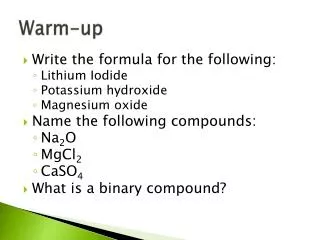
Warm-up • Write the formula for the following: • Lithium Iodide • Potassium hydroxide • Magnesium oxide • Name the following compounds: • Na2O • MgCl2 • CaSO4 • What is a binary compound?
Acids and Bases!!! • Definitions of acid and base • Strong acid/strong base - definition • Some common household examples of each • What formulas may look like (start with, end with, examples) • Properties of acids and bases • pH scale – How do you determine acid or base
Acids and Bases Whitaker 14 May 2014
Acids • Contains more Hydrogen ions (H+) or Hydronium ions (H3O+) than hydroxide ions (OH-) • Formulas start with Hydrogen • pH less than 7 • Properties • Sour taste • React with metals to produce H2 • Reacts with bases to produce a salt and water. • Changes Phenolphthalein clear • Common Acids • Acetic Acid (Vinegar) • Sulfuric Acid (Battery Acid) • Citric Acid (Lemon Juice/Orange Juice/Lime Juice)
Bases • Contains more hydroxide ions (OH-) than Hydrogen ions (H+) or Hydronium ions (H3O+) • Formulas generally end in -OH • pH greater than 7 • Properties • Bitter taste • Feel Slippery/Soapy • Reacts with acids to produce a salt and water. • Changes Phenolphthalein pink • Common bases • Sodium Hydroxide (Drano) • Magnesium Hydroxide (Milk of Magnesia/Antacid) • Sodium Hypochlorite (Bleach)
Naming Bases • These are named just like normal compounds that we’ve already learned about: • NaOH – Sodium Hydroxide • LiOH • Ca(OH)2 • KOH
Naming Acids • There are two types of acids: • Oxyacids • Binary Acids • The type of acid determines how it will be named.
Oxyacids • Contain Polyatomic Ions (will have more than two elements!) • Notice polyatomic ions generally end in either –ate or –ite. • If the polyatomic ends in –ate change the –ate to –icand add acid to the name. • Ex. H2SO4 • If the polyatomic ands in –ite change the –ite to –ous and add acid to the name • Ex. HClO2
Example • Name the following Oxyacids: • HClO3 • H2SO3 • H2CO3 • HNO3 • Write the formula for: • Chlorous acid • Sulfic acid • Nitrous acid
Binary Acids • Contain ONLY two elements!! • Take the root word of the anion (negative ion) and place it into the pattern of hydro_______-icacid • Ex. HCl
Example • Name the following binary acids: • HI • HBr • Write the formula for the following binary acids: • Hydrochloric acid • Hydrofluoric acid
Mixed Examples • Write the formula or name of the following acids: • Acetic Acid • HNO3 • Hydrofluoric acid • H2SO4 • Sulfous acid • HBr
What did you learn today?? • Acids exist at what pH range? • Bases have what taste? • What happens when you mix an acid and a base? • Name the following: • HCl • HClO • Write the formula for the following: • Hydroiodic acid • Chromic acid