Understanding the Light-Dependent Reactions and Calvin Cycle of Photosynthesis
This overview details the critical processes of photosynthesis, including the light-dependent reactions and the Calvin Cycle. Light-dependent reactions occur in the thylakoid membranes, where free electrons gain energy from sunlight, producing ATP and NADPH while releasing oxygen. The Calvin Cycle, which takes place in the stroma, doesn’t require light but utilizes ATP and NADPH to convert carbon dioxide into glucose. This process involves a series of reactions that transform CO2 and energy into sugars, illustrating how plants harness sunlight for growth.

Understanding the Light-Dependent Reactions and Calvin Cycle of Photosynthesis
E N D
Presentation Transcript
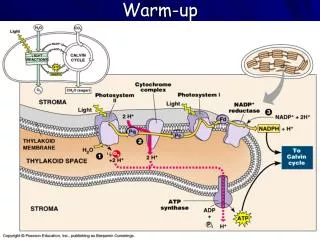
Warm-up • Where do the light-dependent reactions take place? • Where do free e-s first gain E from the sun during the light-dependent reactions? • Where do the free e-s come from? • How do the free electrons use their E going from psII to psI? • What molecule do the free e-s become a part of? • What molecule is made from H+ going down its concentration gradient? a. What is the name of the enzyme they travel through?
The Calvin Cycle • Happens in the stroma, does not require light, but does require the products from the light-dependent reactions • Converts high-E molecules (ATP & NADPH) to sugars • This is where CO2 comes in
Summary of the Calvin Cycle • 6 CO2 molecules enter from the atmosphere & combine with 6 5-C molecules • 6C + 6x5C = 36C • They are converted into 12 3-C molecules • 12 x 3C = 36C • The 3-C molecules convert to higher E forms by taking E from ATP ( ADP) & NADPH ( NADP+) • 2 of the 3-C molecules convert to 6-C sugars (glucose) • The other 10 3-C molecules convert back into 5-C molecules to be used in step 1 • 10 x 3-C = 30C • 6 x 5-C = 30C
Equation of Photosynthesis • Light-dependent Reactions ADP + NADP+ + energy + H2O ATP + NADPH + O2 • Calvin Cycle ATP + NADPH + CO2 ADP + NADP + + C6H12O6 • Together: ADP + NADP+ + energy + H2O + ATP + NADPH + CO2 ATP + NADPH + O2+ ADP + NADP + + C6H12O6 • Overall: (6) CO2 + (6) H2O + energy C6H12O6 + (6) O2 Carbon + water + light sugar + oxygen dioxide