Andrew Jackson
100 likes | 218 Vues
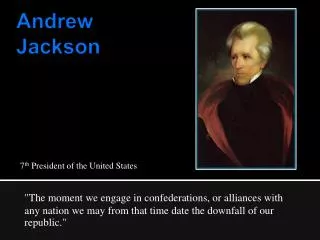
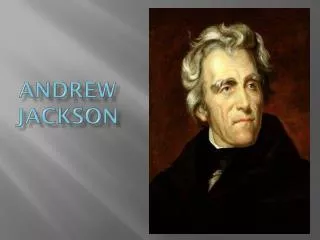
Andrew Jackson, born on the NC/SC border, rose from tragic beginnings as an orphaned teenager amid Revolutionary War struggles. After serving in the local militia, he became a successful lawyer and judge in Tennessee, ultimately purchasing the Hermitage plantation. Known as "Old Hickory," he gained fame during the War of 1812 and entered politics, winning the presidency in 1828 as a champion of the common man. His controversial policies included the Indian Removal Act and opposition to the National Bank, shaping an era of greater democracy and national identity.


Andrew Jackson
E N D
Presentation Transcript
Early Life Born on NC/SC border – at various times will claim origin from NC, SC, and TN.
Revolutionary War • Joins local militia as courier at age 13. • Eldest brother, Hugh, dies in battle. • Jackson and brother Robert are captured by British. • Struggles: starvation, small pox, cholera – then orphaned • Struck by sword of British officer after refusing to clean officer’s boots.
Self-Made Man • Teaches school for one year in NC. • Moves to TN to practice law. Due to background, prospers based on merits – Frontier law. After several years, becomes Judge. • Uses funds to purchase plantation known as The Hermitage – becomes successful planter. Primary crop: Cotton.
War Hero • “Old Hickory” • War of 1812 • Battle of Horseshoe Bend • Battle of New Orleans • Seminole War • Adams-Onis Treaty
Politics • Loses Presidential Election of 1824 • Corrupt Bargain • Victorious in Election of 1828 • Higher Voter Turnout: less restrictive requirements • Common-Man President • First Western President • Re-elected in 1832 • First use of National Convention
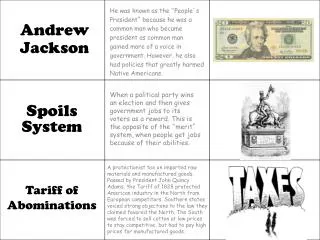
Jackson’s Presidency • Creation of Spoils System • Greater Democracy • “The Great Silence”
Nullification Crisis • Debate over high tariffs • Tariff of Abominations • John C. Calhoun • Theory of nullification • Calhoun’s “S.C. Exposition and Protest” S.C. threatens secession • Jackson threatens the use of force • Henry Clay organizes a compromise
Indian Policies • Different views about Indian policy • Indian Removal Act, 1830 • Cherokee takes the issue to the Supreme Court and wins • Worchester v. Georgia • Jackson ignores the court and orders removal • Trail of Tears, 1838
National Bank • Jackson disliked the Bank of the U.S. • Thought it an abuse of power and served the wealthy first • Thought it lacked the constitutional ability to exist • Jackson vetoed the new charter for the bank and withdrew all gov’t funds • “Pet Banks”