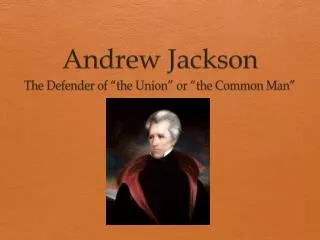
Andrew Jackson: The Rise and Controversies of "Old Hickory"
Andrew Jackson, known as "Old Hickory," won the 1828 presidential election, and his inauguration drew many supporters. He implemented the "spoils system," appointing allies to government positions, alongside his informal advisors, the "Kitchen Cabinet." Jackson opposed the Maysville Road bill, believing states should fund infrastructure. The controversial Tariff of 1828 faced resistance from South Carolina, prompting Jackson's Force Bill. He famously detested the Bank of the U.S., leading to its demise and the Panic of 1837 after redirecting funds to smaller banks and issuing the Specie Circular.

Andrew Jackson: The Rise and Controversies of "Old Hickory"
E N D
Presentation Transcript
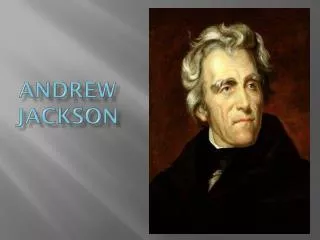
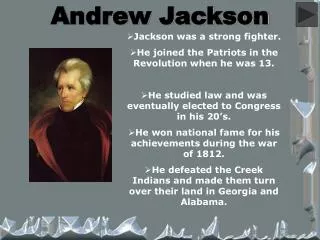
ANDREW JACKSON “OLD HICKORY”
Won the election of 1828 • Many people attended his inauguration
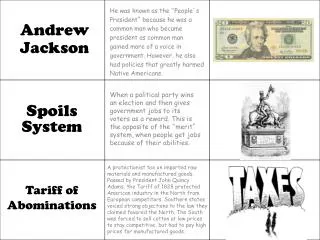
The “spoils system” • Gave government jobs to his supporters • This is also known as patronage
The “kitchen cabinet” • Jackson’s unofficial group of advisors
Maysville Road Veto • Jackson vetoed a bill to build a road across Kentucky because he thought the state should pay for it, not the federal government
Tariff of 1828 • Called the “Tariff of Abominations” by southerners • South Carolina wanted to nullify it • The Force Bill said the president could send troops to collect taxes • Henry Clay helped write a Compromise Bill which reduced the tariff each year
The Bank War • Jackson hated the Bank of the U.S. because he thought it was a monopoly and too powerful • Henry Clay and Daniel Webster submitted a bill to renew the bank’s charter, but Jackson vetoed it • He attacked Nicholas Biddle, the head of the Bank
Jackson also took federal money out of the Bank of the US and put it in smaller “pet banks” • Specie circular is issued – this says that western lands have to be paid for in specie • All this helped to destroy the Bank of the US and led to an economic crisis called The Panic of 1837