Understanding Evolutionary Relationships Through Cladograms and Venn Diagrams
This guide explores the evolutionary relationships among various animals using cladograms and Venn diagrams. It covers the components of Latin species nomenclature and identifies traits such as claws, fur, mammary glands, and shared ancestors. Notably, it discusses the surprising genetic link between hippos and whales, shaped by millions of years of evolution. Additionally, it explains the construction of cladograms based on derived traits, providing step-by-step instructions for comparing organisms. This resource is valuable for anyone interested in animal classification and evolutionary biology.

Understanding Evolutionary Relationships Through Cladograms and Venn Diagrams
E N D
Presentation Transcript
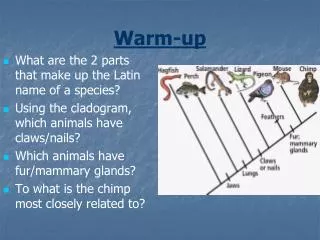
Warm-up • What are the 2 parts that make up the Latin name of a species? • Using the cladogram, which animals have claws/nails? • Which animals have fur/mammary glands? • To what is the chimp most closely related to?
Is a hippopotamus more closely related to a pig or to a whale? List 3 reasons to defend your answer.
HIPPO WHALE Based on physical comparisons (particularly dental structure and number of toes) it was originally thought that hippos were most closely related to pigs but DNA analysis indicates that hippos are more closely related to whales!
Evolutionary Link • Whales and hippos had a common water-loving ancestor 50 to 60 million years ago that evolved and split into two groups: • The pig-like anthracotheres – died out less than 2.5 million years ago, leaving only the hippo as a descendent • The cetaceans (whales, dolphins, and porpoises)
Cladograms are used to… • Organize organisms based on evolutionary relationships (phylogeny). • In other words… who is related to who and where did we come from…
How are cladograms constructed? • Organisms are grouped together based on their shared derived characteristics (trait modified from the ancestral trait).
Cladogram construction • Given a table of derived characters (traits), create a cladogram
Step 1 – Create a Venn Diagram • How many organisms are you comparing? • This number will equal the number of circles in your Venn diagram. • Now count the number of characters each organism has. • This will be the order that you place the organisms in the Venn Diagram.
Venn Diagram Placenta: Human Mammary glands: Kangaroo & Human Two pairs of limbs: Bullfrog, kangaroo & Human Vertebrae: Shark, bullfrog, kangaroo & humans
Step Two – Convert the Venn Diagram into a Cladogram Kangaroo Bullfrog Human Shark Placenta Mammary Glands Two pairs of limbs Vertebrae
Human Human: hair Lizard: legs Trout: Vertebrae Earthworm
Convert the Venn Diagram into a Cladogram Lizard Trout Human Earthworm Hair Legs Vertebrae