Understanding Conditional Probability Through Survey Data and Game Outcomes
This document explores conditional probability using real-life survey data related to food preferences, pet ownership, and male-female comparisons. It includes problems where students assess the likelihood of liking certain fast-food restaurants based on gender and determine probabilities involving carnival game outcomes. Key exercises include calculating conditional probabilities using data tables and scenarios. Through these examples, learners gain insight into probability concepts and the importance of sample space limitations.

Understanding Conditional Probability Through Survey Data and Game Outcomes
E N D
Presentation Transcript
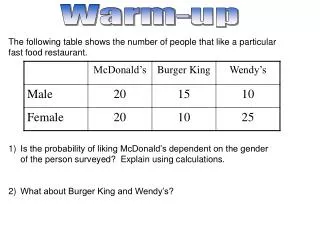
Warm-up • The following table shows the number of people that like a particular fast food restaurant. • Is the probability of liking McDonald’s dependent on the gender of the person surveyed? Explain using calculations. • What about Burger King and Wendy’s?
Warm-up • Howard is playing a carnival game. The object of the game is to predict the sum you will get by spinning spinner A and then spinner B. Howard predicts he will get a sum of 5. • List the sample space. • What is the probability Howard gets a sum of 5? • Suppose that Howard gets a 3 on Spinner A, what is the new probability of him getting a sum of 5? 3/12 or 1/4 1/3
Conditional Probability • Conditional Probability contains a condition that may limit the sample space for an event. • You can write a conditional probability using the notation - This reads “the probability of event B, given event A”
yes no female 8 6 male 5 7 Do you own a pet? 8 14 Therefore, P(own a pet | female) equals . Conditional Probability The table shows the results of a class survey. Find P(own a pet | female) 14 females; 12 males The condition female limits the sample space to 14 possible outcomes. Of the 14 females, 8 own a pet.
yes no female 7 6 male 7 8 Did you wash the dishes last night? 7 15 Therefore, P(wash the dishes | male) Conditional Probability The table shows the results of a class survey. Find P(wash the dishes | male) 13 females; 15 males The condition male limits the sample space to 15 possible outcomes. Of the 15 males, 7 did the dishes.
Material Recycled Not Recycled Paper 34.9 48.9 Metal 6.5 10.1 Glass 2.9 9.1 Plastic 1.1 20.4 Other 15.3 67.8 20.4 48.9 + 10.1 + 9.1 + 20.4 + 67.8 P(plastic | non-recycled) = 20.4 156.3 = 0.13 Let’s Try One Using the data in the table, find the probability that a sample of not recycled waste was plastic. P(plastic | non-recycled) The given condition limits the sample space to non-recycled waste. A favorable outcome is non-recycled plastic. The probability that the non-recycled waste was plastic is about 13%.
Conditional Probability Formula • For any two events A and B from a sample space with P(A) does not equal zero
Relate: P( male ) = 58% P( male and jogs ) = 20% Define: Let m = male. Let j = jogs. P( m and j ) P( j ) Write: P( j | m ) = 0.2 0.58 = Substitute 0.2 for P(A and B) and 0.58 for P(A). 0.344 Simplify. Conditional Probability Researchers asked people who exercise regularly whether they jog or walk. Fifty-eight percent of the respondents were male. Twenty percent of all respondents were males who said they jog. Find the probability that a person randomly selected jogs given they are male. The probability that a male respondent jogs is about 34%.
yes no female 8 6 male 5 7 Do you own a pet? 4 7 Therefore, P(own a pet | female) equals . Conditional Probability – Pets Revisited The table shows the results of a class survey. Find P(own a pet | female) 14 females; 13 males
Homework • Practice Worksheet