Warm-Up
Dive into the essential concepts of solving linear equations and understanding metric conversions. This lesson focuses on the importance of grasping the relationships between various quantities as we solve different mathematical problems. You'll explore how to calculate area, volume, and surface area using real-world examples, such as finding the area of a paper and the volume of a canister. Clear steps are provided to guide you through solving equations and applying metric conversions to enhance your algebra skills.

Warm-Up
E N D
Presentation Transcript
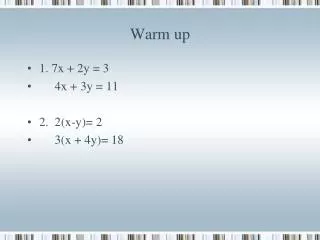
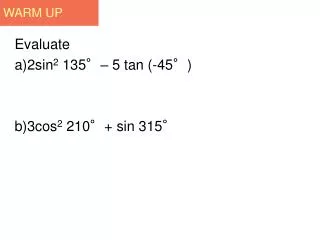
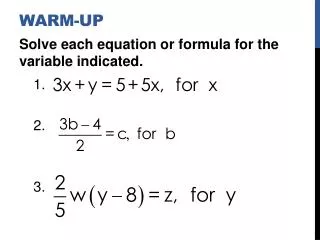
Warm-Up • Solve each equation or formula for the variable indicated. 1. 2. 3.
CCGPS Coordinate Algebra UNIT QUESTION: Why is it important to understand the relationship between quantities? Standard: MCC9-12.N.Q.1-3, MCC9-12.A.SSE.1, MCC9-12.A.CED.1-4 Today’s Question: What steps are used in solving linear equations? Standard: MCC9-12.A.CED.1
Metric Conversions K H D B D C M BASES: Liter, Meter, Gram illi eci ilo enti eka ecta ASE
Ex 1: Finding area • Your paper is 8.5 inches wide and 27.94 centimeters long. Find the area of the paper in centimeters. A = 603.2246 cm2
Ex 2: Finding volume • You are trying to fill a canister full of Pringles. The canister has a radius of 3.5 cm and a height of 95m. Find the volume of the canister in cm. V = 365,602.8451 cm3
Ex 3: surface area • You are wrapping a gift for your mother’s birthday. The box is 1 ft wide, 22.86 cm long, and 152.4 mm tall. Find the surface area of the box so you know how much wrapping paper you will need in cm. SA = 3019.3488 cm2
Daily check Clear your desk. You need a pencil and a calculator.
CW/HW • Worksheet • On #4 find your answers in cm • On #5 find your answer in m • On #6 find your answers in m