Understanding Minerals and Rocks: A 1st Grade Guide to Earth's Crust
Discover the fascinating world of minerals and rocks suitable for 1st graders! Learn about how the Earth’s crust is formed from rocks made up of minerals, which are natural, solid substances defined by their unique properties. The lesson covers important concepts such as the types of rocks (sedimentary, metamorphic, and igneous), the characteristics of minerals (like color, luster, and hardness), and the rock cycle. Engaging activities related to real-world examples help young learners grasp these scientific principles with ease.

Understanding Minerals and Rocks: A 1st Grade Guide to Earth's Crust
E N D
Presentation Transcript
MINERALS AND ROCKS 1st grade
TheEarth’scrustismade up of ROCKS.The rock ismade up of minerals.
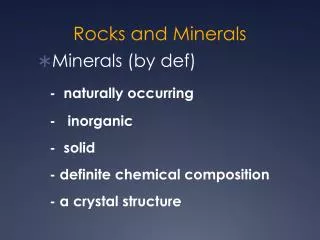
MINERAL: • A MINERAL IS A SOLID SUBSTANCE WHICH ORIGINATES THROUGH ONE OF THE EARTH’S NATURAL PROCESSES. • The general definitionencompassesthefollowingcriteria: • Natural occurring • Stable at roomtemperature • Representedby a chemical formula • Usuallyabiogenic • Orderedatomicarrengement
MOST COMMON ELEMENTS IN MINERALS: • Oxygen • Silicon • Aluminium • Iron • Calcium • Sodium • Potassium • Magnesium
CRYSTAL • Whentheexternalshape of the mineral reflectsitsinternalstructure, wecallit a crystal. • (Crystal of AmethystQuartz) (Cuarzo amatista)
PHYSICAL PROPERTIES OF MINERALS • COLOUR: someminerals are alwaysthesamecolour (cinnabar), othersshawvariety of colour. (Quartz) • LUSTER (brillo):itishowminerals look whenitreflects light: metallic,vitreous, pearly,dullorgreasy.
PROPIERTIES • HARDNESS (dureza): itmeasuresthecomparativeeaseordifficultywithwhich a mineral maybescratched. • Fingernail: lowhardness • Nail: medium • Itscatchesglass: high • Mohs scale
PHYSICAL PROPERTIES • STREAK (RAYA): itisthecolour of the mineral whenitismadeintopowder. • FRACTURE AND CLEAVAGE (Fractura): itisthetendency of a mineral to break along irregular surfaces (fracture) oralong flat planarsurfaces (cleavage).
ROCKSAggregates of mineralswhichhavebeenformed in a natural process.Accordingtothatprocessrocks can besedimentary, metamorphicorigneus.
SEDIMENTARY ROCKS • These are formedfrommaterialscalledsediments, which are slowlydeposited in someareas (oceans and lakes). • Sedimentsaccumulateforming horizontal layeerscalledstrata. • Examples: limestone: piedra caliza • sandstone: arenisca
METAMORPHIC ROCKS • These are formedfromotherrocksthat are transformedbythehighpressure and temperature in deepzones of theEarth’scrust. Theprocessiscalledmetamorphism. • Claychangesintoslate. (arcilla se transforma en pizarra) • Limestonechangesintomarble .(caliza se transforma en mármol)
MAGMATIC OR IGNEOUS ROCKS • In deepzones of theEarth’scrustthere are extremlyhightemperatureswhich can meltrocks, whichbecomemoltenmaterialscalledmagama. Whenthis magma coolsdown and solidifies, itformsigneusrocks. • Plutonicrocks: magma coolsdownveryslowlyundertheEarth. Granite (granito) • Volcanicrocks: magna coolsdownquickly as it comes out of thevolcano. Basalt and pumice (basalto y pumita)