Understanding Graph Transformations: An Introduction to Vertex and Parent Functions
This guide focuses on translating graphs, which involves shifting them up, down, left, or right. By understanding the general transformation equations, we can describe the location of a graph through its vertices. The key points include identifying parent functions, understanding vertical and horizontal shifts, and recognizing the significance of the vertex in determining graph transformations. We provide examples and practice problems to reinforce learning. By the end, you will know how to identify vertices and write equations that represent the shifted graphs.

Understanding Graph Transformations: An Introduction to Vertex and Parent Functions
E N D
Presentation Transcript
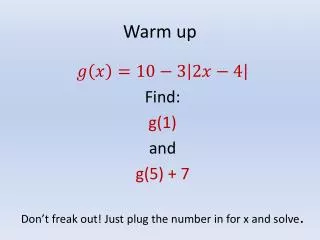
Warm up Find: g(1) and g(5) + 7 Don’t freak out! Just plug the number in for x and solve.
What does this mean? • Simply picking up a graph, and moving it. Either up and down, or side to side.
What these can look like… • Same graph, just in a new location
We need a way to explain the location of a graph using equations.
First we need to know the general equation for each function. They are called the Parent Functions
What is a vertex? • The peak in the curve, or the tip of the graph. • We will use the vertex to figure out where the graph moved.
What is the coordinates for the vertex of the blue graph? • (0,0) • Of the red? • (-3, .5)
What is the coordinates for the vertex of the blue graph? • (0,0) • Of the red? • (3, 0)
Looking at the vertex is the easiest way to tell where the function shifted.
General Transformation Equation • k=vertical shift (up and down) • +k is up • -k is down. • h=horizontal shift (side to side) • (x-h) is shifted to the RIGHT • (x+h) is shifted to the LEFT
Example 1: (blue is original, red is shifted) • Questions to ask yourself • What is the parent function? y=x 2. Has it shifted left or right? No 3. Has it shifted up/down? Yes, it went up 3. 4. What is the equation?
You try! Blue is original. • Answer:
Homework • Problems 1 and 2 • For 2, identify the vertices AND write an equation for each graph.