Understanding the Discriminant: What to Expect for Quadratic Equations
This guide provides a comprehensive overview of using the discriminant to determine the number of solutions for quadratic equations. Explore how the value of the discriminant—expressed as b² - 4ac—indicates whether there are two solutions, one solution, or no real solution. This essential concept helps in graphing quadratic functions and identifying x-intercepts. We include examples and checkpoints to enhance understanding and application of the discriminant in different quadratic scenarios.

Understanding the Discriminant: What to Expect for Quadratic Equations
E N D
Presentation Transcript
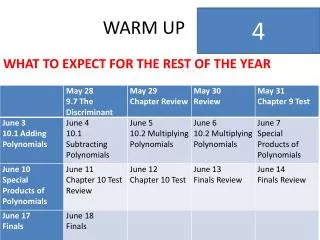
WARM UP 4 WHAT TO EXPECT FOR THE REST OF THE YEAR
WARM UP 3 WHAT TO EXPECT FOR THE REST OF THE YEAR
WARM UP 2 WHAT TO EXPECT FOR THE REST OF THE YEAR
WARM UP 1 WHAT TO EXPECT FOR THE REST OF THE YEAR
WARM UP 0 WHAT TO EXPECT FOR THE REST OF THE YEAR
9.7 Using the Discriminant GOAL Use the discriminant to determine the number of solutions of a quadratic equation. KEY WORDS Discriminant
9.7 Using the Discriminant In the quadratic formula, the expression inside the radical is the DISCRIMINANT. x = DISCRIMINANT - 4ac
9.7 Using the Discriminant • Consider the quadratic equation ax2+ bx + c = 0 • If the value of b2 – 4ac is positive, then the equation has two solutions. • If the value of b2 – 4ac is zero, then the equation has one solution. • If the value of b2 – 4ac is negative, then the equation has no real solution. THE NUMBER OF SOLUTIONS OF A QUADRATIC EQUATION
9.7 Using the Discriminant x-intercept Because each solution of ax2 + bx + c = 0 represents an x-intercept of y = ax2 + bx + c, you can use the discriminant to determine the number of times the graph of a quadratic function intersects the x-axis. These points are called the x-intercepts or roots. x-intercept (-1, 0) (2, 0) y = x2 – x - 2
9.7 Using the Discriminant Checkpoint Find the Number of Solutions. Find the value of the discriminant. Then use the value to determine whether the equation has two solutions, one solution, or no real solution. -3x2+2x -5= 0 2x2-3x -4= 0 5x2-4x +2= 0