Lesson 19: Global Climate Change
160 likes | 284 Vues
This lesson explores Asia's significant contribution to global CO2 emissions, highlighting China's ascendancy as the second-largest emitter, followed by Japan and South Korea. It examines land use changes, particularly deforestation, and predicts severe impacts like sea-level rise threatening millions in coastal cities. Key concerns include increased flooding risks and changing climate patterns affecting water resources. The importance of proactive adaptation strategies is underscored, particularly in vulnerable regions such as mega-deltas. Equity issues between and within countries are also discussed, emphasizing the need for sustainable growth and access to resources.


Lesson 19: Global Climate Change
E N D
Presentation Transcript
Lesson 19: Global Climate Change Amy Duray EVPP 490 003 April 19, 2010
Asia’s Changing Role in Climate Change • 3 of the top 8 emitters of man-made CO2 emissions: China, now 2nd, likely to become 1st by 2010), Japan 5th and S. Korea 8th. ( BBC News video: Why emissions are rising in China.) • These rankings are industrial sources only and don’t consider other CO2 emitting activities common in Asia, such as burning of firewood and other biomass for domestic energy. • Land use changes (esp. the conversion of forests) make significant contributions to CO2 global changes (such as what we see in the Philippines and Indonesia).
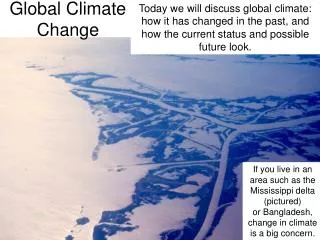
Effects of GCC in Asia a. Sea-level rise: (1) Submergence of Small Islands (2) Impacts to large coastal cities (Jakarta, Bangkok, Manila, Shanghai especially vulnerable) – 10s of Millions may be displaced. (3) Infrastructure spending (levees, etc.) to protect cities. (4) Increasing human vulnerability
Global Mean Sea-Level - 17cm rise for the past 100 yrs - Present speed of SLR is 3.2 mm/yr. - In a long tem, collapse of Greenland ice sheet may induce 2-7m SLR. (IPCC WGI AR4, 2007)
Risk to Mega Delta Regions Vulnerability of Mega-deltas ・Several millions more people will be flooded annually. ・Proactive and planned adaptation is necessary. Extreme: >One million(by 2050) High: 50 K to one million Medium: 5K to 50 K (IPCC WGII AR4, 2007)
Changes in Hydrologic Flow This map shows the change in run-off inferred from streamflow records worldwide between 1948 and 2004, with bluish colors indicating more streamflow and reddish colors less. Graphic: Journal of Climate, modified by UCAR
Drivers and Pressures of CO2 and GHG emissions • Natural • Anthropogenic
Equity Issues in GCC (1) Between countries: Asia wants to ensure that their countries have the ability to achieve a certain level of economic growth and wellbeing for citizens. Despite the changes in CO2 contributions, the average American contributes 4 times the CO2 as the average Chinese. (Siddiqi, 2008) (2) Within countries: Still a large rural-urban divide in the Developing countries of Asia, not seen in the fully developed economies of N. America and Europe. More than 100M people in Asia have no access to electricity. (Siddiqi, 2008) (3) Intergenerational Equity: Assuring continuing availability/access for future generations. Manifests itself in CO2 emissions, natural resources consumption, and excess debt.
China and Global Climate Change • China’s willingness • 2 Degree limit by 2050 • 1/3 of China’s current GHG emissions attributed to exports