
Rock Formation and Types: Igneous and Sedimentary Rocks
E N D
Presentation Transcript
ROCKS Chapter 6
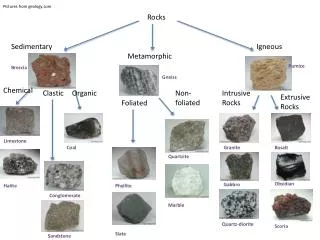
What is a Rock? • A group of minerals bound together • Can be mostly one mineral or several different minerals • Classified according to how they are formed. • 3 types
Rock Formation • Igneous: cooling and hardening of hot, molten rock, or magma, from inside the Earth.
Rock Formation • Sedimentary: compacting and cementing of layers of sediment. • Sediments – rock fragments, plant & animal remains, minerals that settle onto lake and ocean bottoms
Rock Formation • Metamorphic: formed by the effect of heat and pressure on other rocks
Igneous Rocks • Classified according to their mineral composition and texture • Made up of volcanic ash or magma • Texture depends on the cooling rate
Types of Magma • Felsic • Thick and slow-moving • Mostly Silica with some calcium, iron, and magnesium • Forms light-colored rocks - ex: quartz and orthoclase feldspar
2. Mafic • Hotter, thinner and more fluid • Mostly iron and magnesium with some silica • Usually have large amounts of dark silicate minerals such as hornblende, augite, and biotite.
Rate of Magma Cooling Depends on where the magma cooling occurs Underground: • Magma cools very slowly (thousands of years) • Called Intrusive Rock • Course-grained texture • has time to form large crystals
At the Surface: • Volcanic eruptions release lava • Cools and hardens very quickly • Called Extrusive Rock • Fine-grained texture • Does not have time to form large crystals = glassy
Sometime underground magma begins to cool and is then suddenly forced to the surface • Creates a rock with large crystals surrounded by tiny crystals called porphyry
Igneous Rock Families • Grouped according to mineral composition. May include intrusive and extrusive rocks. • Granite Family • Gabbro Family • Diorite Family
Granite Family • Form from Felsic Magmas • Usually Coarse-grained • Typically contain quartz, feldspar, mica, and hornblende minerals Members: Granite, Obsidian, Pumice, Felsite, Rhyolite
Granite Rocks • Intrusive • Coarse-grained • Color: ranges from white or gray to pink • Commonly found in Mountainous areas
Gabbro Family • Mafic rock • Dark in color and denser than Granite
Diorite Family • Intermediate composition – neither felsic or mafic • Color: medium grays and green (darker than granites and lighter than gabbros)
Igneous Intrusions • Volcanoes give only a hint of the amount and the activity of the magma that exists below Earth’s surface • Forces deep with Earth may push magma into fractures in the bedrock. • Magma may be squeezed between rock layers, forcing the overlaying rocks upward to for domes • Great masses of magma may solidify far below the surface to form the cores of mountains
Pluton • Any igneous intrusion • A rock mass that forms when magma cools inside Earth’s interior • Pluton reaches Earth surface only after uplift and/or weathering take place.
Dikes • A sheet of igneous rock that cuts across rock layers vertically or at a steep angle • Formed when magma intrudes into angled cracks • May be hundreds of kilometers long and range from about a centimeter to many meters thick • Common in regions of volcanic activity
Sills • Sheet of igneous rock that lies parallel to the layers it intrudes • Formed when magma is forced between, not across, rock layers • Can be hundreds of meters thick and many kilometers long
Laccoliths • Magma that is stiff and does not flow easily • Forms a domed mass • The rock layers above laccoliths are also pushed upward to form a dome
Batholiths • Largest of all plutons • Forms the cores of many of Earth’s mountain ranges • Usually made of granite or granodiorite and can be thousands of square kilometers • Is exposed through uplift and erosion of overlaying rock layers
Sedimentary Rocks • Form through the compacting and cementing of layers of sediment. • 3 Types of Sedimentary Rocks • Clastic Rocks • Chemical Rocks • Organic Rocks
Clastic Rocks • Formed from fragments of other rocks • Fragments come from the weathering of igneous, metamorphic, and other sedimentary rocks • Fragments rage from the size of pebbles to microscopic flakes
Clastic Rock Formation • Many fragments are moved by running water • Movement causes fragments to become smooth
Fragments are deposited in lakes or oceans • Larger fragments fall out and settle first then smaller particles • Over time settled fragments become cemented with silica, calcite, iron oxide or clay mineral. • Pressure can also cause sediments to stick together
Clastic Rock Examples 1. Conglomerate • Large fragments ranging from gravel to boulders • Any mineral composition • Porosity and permeability depend on the degree of cementation
2. Sandstone • Small particles – about the size of the head of a pin • Commonly quartz grains • Often highly porous and permeable
3.Shale • Sediments very small about the size of flour particles • Clay minerals • Not very porous or permeable
Chemical Rock Formed from the accumulation of dissolved minerals in water Examples: Halite and Rock gypsum
Organic Rock • Formed from sediment remains of plants and animals Example: Limestone
Features of Sedimentary Rocks • Stratification: visible layers • Formed when different types of sediments are laid down
Fossils: the remains, impressions, or any other evidence of a plant or animal preserved in rock. • Sediment covers the animal/plant filling in all of the pores which gradually turn into stone.
Ripple Marks: sand patters formed by wind, streams or waves that harden into stone.
Mud Cracks: form when deposits of wet clay dry and contract. Cracks become filled with different sediments and fossilize.
Nodules, Concretions, and Geodes • Nodules: lumps of fine-grained silica within limestone • Concretions: round, solid masses of calcium carbonate within shale • Geodes: spheres of silica rock within limestone
Describe three features of sedimentary rocks. Which feature is common to nearly every type of sedimentary rock?
Metamorphic Rock Metamorphism: process by which a rock’s structure is changed by pressure, heat, and moisture. • Are formed from preexisting rocks called parent rocks • May cause a change in chemical composition, texture, or internal structure • Pressure may force grains closer together, making the rock more dense and less porous.
Draw a picture of a conglomerate rock • Draw a second picture of how you think that rock will look once it has undergone metamorphic pressure
2 Types of Metamorphism • Regional • Local
Regional Metamorphism • Large areas of rock change form after exposure to intense heat and pressure • As mountains form, deeply buried rocks are subjected to high heat and pressure
Local Metamorphism 2 Types • Contact Metamorphism: hot magma moves into the rock, heating and changing it
2. Deformational Metamorphism: • Occurs at lower temperatures and at high pressure caused by stress and friction • Often along fault lines • As the masses move, heat and pressure cause the rock to deform (change shape).