Understanding Molecular Structure with Lewis Structures and VSEPR Model
Learn about polar and nonpolar covalent bonds, molecular geometry, and apply the VSEPR model to molecules with double bonds. Practice drawing Lewis structures for CH4, NH3, H2O, and more in a virtual lab.

Understanding Molecular Structure with Lewis Structures and VSEPR Model
E N D
Presentation Transcript
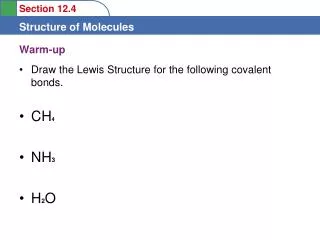
Warm-up • Draw the Lewis Structure for the following covalent bonds. • CH4 • NH3 • H2O
Objectives • SWBAT understandmolecular structure, be able to predictmolecular geometry from the number of electron pairs and to apply the VSEPR model to molecules with double bonds in a virtual laboratory.
Polar Covalent Bonds – 2a.3 • When atoms of different electronegativities bond, they don’t share electrons equally. • This unequal sharing of electrons results in a polar covalent bond. How are polar covalent bonds different from regular (nonpolar) covalent bonds?
A. Molecular Structure • Three dimensional arrangement of the atoms in a molecule • Water - bent LQHS
A. Molecular Structure • Linear structure – atoms in a line • Carbon dioxide
A. Molecular Structure • Trigonal planar – atoms in a triangle • BF3
A. Molecular Structure • Tetrahedral structure • methane
B. The VSEPR Model • Valence shell electron pair repulsion (VSEPR) model • Molecular structure is determined by minimizing repulsions between electron pairs
B. The VSEPR Model • 180o - linear • Two Pairs of Electrons • BeCl2
B. The VSEPR Model • 120o – trigonal planar • Three Pairs of Electrons • BF3
B. The VSEPR Model • 120o – tetrahedral • Four Pairs of Electrons • CH4
C. Molecules with Double Bonds • When using VSEPR model to predict molecular geometry of a molecule • a double bond is counted the same as a single electron pair
Practice – Draw the Lewis Dot and Determine the Shape • CL2 Virtual Lab LQHS
Practice – Draw the Lewis Dot and Determine the Shape • SiCl4
Practice – Draw the Lewis Dot and Determine the Shape • AsH3