Understanding Polynomial Graphing: Roots, End Behavior, and Classifications
170 likes | 266 Vues
Dive into the world of polynomial graphing with a focus on understanding equations, roots, and end behavior. This resource introduces key concepts including the classification of roots (single, double, triple) and the behavior of polynomial graphs as they interact with the x-axis. Discover how end behavior is determined by the leading term's degree and how to sketch polynomial graphs while accurately labeling their roots. Engage with practice problems designed to reinforce learning and deepen comprehension of polynomial properties.


Understanding Polynomial Graphing: Roots, End Behavior, and Classifications
E N D
Presentation Transcript
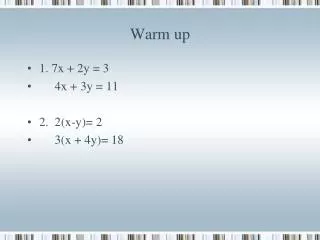
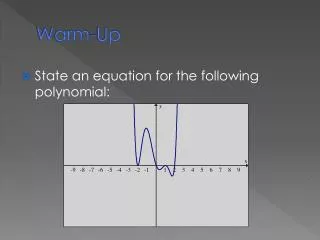
Warm-Up • State an equation for the following polynomial:
Learning Targets • End Behavior • Turns or “Bumps” for each polynomial • Investigate Roots
Types of Roots • Polynomial solutions are made up of complex roots • A root is where the polynomial’s graph will intersect with the x-axis • A complex root describes two different types of roots: • Real Roots • Imaginary Roots (we will get to these next week)
Root Classifications • We classify the type of Real Root based on the degrees of each term and how it interacts with the x-axis. • Types: • Single Root • Double Root • Triple Root • And so on…
Examples: • Single Roots
Examples: • Double Roots
Examples: • Triple Roots
You Try • Classify each type of root:
Practice • Sketch the following polynomials, describe the end behavior and classify the roots: • 1) • 2) • 3)
#1 This is only a sketch
#2 This is only a sketch
#3 This is only a sketch
Turns In a Graph • What determines the number of turns the graph of a polynomial will have? • End Behavior • Degree of the Leading Term • Degrees of each factor, or the types of roots • The maximum number of turns a polynomial can have is (n-1) where n is the degree of the leading term
For Tonight • On the worksheet from Thursday: • Describe the end behavior using the correct math notation • Circle each root on the graph. • Label each root as single, double or Triple.
http://www.wired.com/images_blogs/wiredscience/2013/10/600-grey-goblin.gifhttp://www.wired.com/images_blogs/wiredscience/2013/10/600-grey-goblin.gif