Understanding Functions and Interval Notation in Math
Learn about domains, ranges, and functions in mathematics. Understand the difference between continuous and discrete functions, with examples and exercises included. Improve your math skills today!

Understanding Functions and Interval Notation in Math
E N D
Presentation Transcript
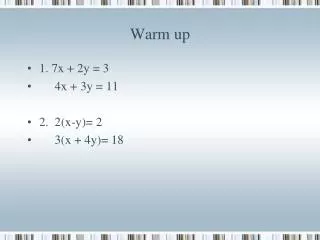
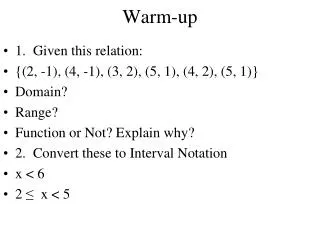
Warm-up • 1. Given this relation: • {(2, -1), (4, -1), (3, 2), (5, 1), (4, 2), (5, 1)} • Domain? • Range? • Function or Not? Explain why? • 2. Convert these to Interval Notation • x < 6 • 2 ≤ x < 5
Warm-up • 1. Given this relation: • {(2, -1), (4, -1), (3, 2), (5, 1), (4, 2), (5, 2)} • Domain? {2,3,4,5} • Range? {-1,1,2} • Function or Not? NO, duplicated “x” values • 2. • x < 6 in interval notation (-∞, 6) • 2 ≤ x < 5 in interval notation [2, 5)
Continuous Functionsvs Discrete FunctionsDomain and Range Chapter 2 Section 2-1 Pages 72-81
Objectives • I can determine Domain and Range from a Continuous Graph • I can identify a discrete and continuous function
Important Vocabulary • Discrete Function • Continuous Function
Discrete Function • A function with ordered pairs that are just points and not connected.
Continuous Functions?? • A function is continuous if it has an infinite domain and forms a smooth line or curve • Simply put: It has NO BREAKS!!! • You should be able to trace it with your pencil from left to right without picking up your pencil
y x 4 -4 The domain of the function y = f(x) is the set of values of x for which a corresponding value of y exists. Domain & Range The range of the function y = f(x) is the set of values of y which correspond to the values of x in the domain. Range Domain
Example: Domain & Range y 1 (–3, 0) x – 1 Example: Find the domain and range of the function f(x) = from its graph. Range Domain The domainis[–3,∞). The rangeis[0,∞).
Homework • WS 1-5: Domain and Range