Ion Population of Fe in CIE: Insights for Supernova Remnants and APEC Dataset Utilization
110 likes | 269 Vues
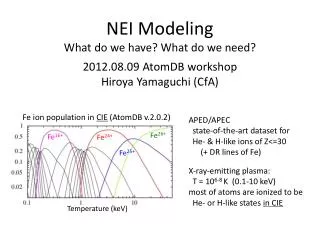
This work discusses the ion population of iron (Fe) in Collisionally Ionized Equilibrium (CIE) and its implications for Supernova Remnants (SNRs). Utilizing AtomDB v2.0.2, the study focuses on various Fe ion states—Fe16+, Fe24+, Fe25+, and Fe26+—within hot X-ray-emitting plasma at temperatures between 10^6 and 10^8 K. The paper presents an analysis of emission spectra, inner-shell processes, and the importance of atomic data for accurate modeling of SNR spectra. It highlights advancements using APEC and APED datasets and outlines further needs for precise data on heavy elements.


Ion Population of Fe in CIE: Insights for Supernova Remnants and APEC Dataset Utilization
E N D
Presentation Transcript
NEI ModelingWhat do we have? What do we need? Fe ion population in CIE (AtomDB v.2.0.2) APED/APEC state-of-the-art dataset for He- & H-like ions of Z<=30 (+ DR lines of Fe) Fe26+ Fe16+ Fe24+ 2012.08.09 AtomDB workshop Hiroya Yamaguchi (CfA) Fe25+ X-ray-emitting plasma: T = 106-8 K (0.1-10 keV) most of atoms are ionized to be He- or H-like states in CIE Temperature (keV)
Supernova Remnants = NEI !! E0102-72 H-dominant (solar abundance) matter heavy elements are neutral metal-rich, almost neutral Shock-heated electrons ionize heavy elements. t = ne t = 1012 (cm-3s) t = 30000 (ne /1cm-3)-1 yr
Supernova Remnants = NEI !! Fe ion population in NEI (AtomDB v.2.0.2) typical SNRs Fe24+ Fe16+ Fe26+ Fe25+ kTe = 20 keV ne t (cm-3s) - Inner-shell process is essentially important for SNRs! - APEC can calculate ion population, but doesn’t output emission.
SNRs’ spectra of Fe K-shell band Fe Ne-like 3C397 (Type II) He-like neutral Cr Mn Ni W49B N103B CasA 0519 Tycho 0509 3C397 G349 Kepler G344 N132D RCW86 G292 Kepler (Type Ia) G350 G272 SN1006 Fe Kb 9 6.44 keV -> Fe XVII-XVIII (Palmeri+03)
Innershell process - Innershell ionization/excitation - Fluorescence or Auger (Kaastra & Mewe 93) … SPEX, XSPEC NEI v.1 Innershell ionization of Be-like ions Li-like : 1s2s2 (2S) -> wK = 0 (for single-configuration wave function) in fact, K&M(1993) gave zero values for every Li-like ions. Configuration interaction (CI) effect cannot be ignored yCI = c1 1s2s2 (2S) + c2 1s2p2 (2S) ; c2 ~ 0.3 (Gorczyca+2006) wK ≠ 0 ! Li-like this work (Gorczyca+06) K&M93 l Fe Kaa energy (Mendoza+04) # of electrons
Atomic data for emission above 5 keV Kris Kris DR data for Fe e.g., Bautista & Badnell 07
Atomic data for emission below 5 keV Ar, Aa, l (Ka) for all ionization states Palmeri+08b, Kucas+12: Ne, Mg, Si, S, Ar, Ca Palmeri+11: Al Palmeri+12: Na, Cl, Ti, Zn, etc.(Z <= 30) No longer need Kaastra & Mewe’s data Lighter elements are usually ionized to be He-like state. but a few exception… 0509-67.5: Kb from low-ionized Si (Warren & Hughes 04) Tycho: low-ionized Ca (Hwang+98) Also needed: Si thru Ca (Ne-like – Li-like) and L-shell data for Fe, Ca, Ni, … Si XII S XIV Fe L Ar XVI Fe Ca XVIII Kepler
Recombining plasma W49B (Ozawa+09) Fe24+ Ka What’s the origin? - collision with dense stellar wind matter and following adiabatic cooling? (HY+09) - thermal conduction into cloudy matter? (Zhou+11) Abundance & density are important information. RRC (Fe25+ -> Fe24+)
Recombining plasma W49B (Ozawa+09) Fe24+ Ka RRC (Fe25+ -> Fe24+) a (recomb rate) : Badnell+06 k = nFe25+/ (nFe26+ + nFe25++ nFe24++ …) We only know nFe25+ /nFe24+ from the RRC/line ratio… (~ 0.06 in W49B) Fe ion population in CIE (Mazzotta+98) Fe24+ Fe26+ Fe16+ We (wrongly) assumed that ion pop in arbitrary recomb plasma is consistent to that in CIE plasma with a certain electron temperature. Fe25+ then, used k= 0.04 to estimate Fe abundance and density. Temperature (keV)
Recombining plasma CIE Fe26+ Fe24+ Fe16+ Fe25+ temperature (keV) kTe = 0.5 keV ne t (cm-3s) Ionizing Recombining plasma model in XSPEC must be useful. We do already have atomic data! ne t (cm-3s) Some difficulty… Ionizing: kTe, net, abundances, normalization Recombining: + initial ion population -> 3-dimensional
Summary Ionizing NEI plasma - APEC is ready. - Fluorescence data are completed for all elements (Z <=30)! except for Kb lines from lowly-ionized atoms (Kaastra & Mewe’s is no longer needed.) - EII/EIE rates for Fe & Ni are calculated by Kris & collaborators! - EII/EIE rates for Cr & Mn would be mostly important now. - and other abundant elements, Si, S, Ca… Recombining plasma - APEC & APED are both (almost) ready. - one more parameter (init ion pop.) is needed.