Understanding the Types and Effects of Weathering on Rocks
Weathering is the natural process that breaks down rocks and minerals at Earth's surface into smaller pieces. There are two primary types of weathering: mechanical (or physical) weathering, where rocks are broken into smaller fragments without altering their composition, and chemical weathering, which alters the minerals within the rock. Factors affecting the rate of weathering include rock type and climate conditions. For instance, wetter environments tend to promote faster weathering, while drier areas, like deserts, see much slower deterioration. Understanding these processes provides insight into geological and environmental changes over time.

Understanding the Types and Effects of Weathering on Rocks
E N D
Presentation Transcript
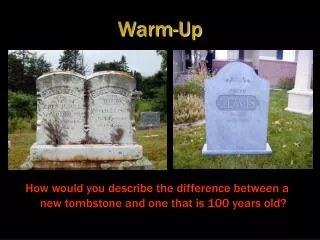
Warm-Up How would you describe the difference between a new tombstone and one that is 100 years old?
The Effects of Weathering • Weathering is the process that breaks down rocks and other substances at Earth’s surface Sierra Nevada Mtns. ~20 myo Appalachian Mtns. ~250 myo
Two Types of Weathering • Mechanical (physical) • Chemical
Two Types of Weathering • MechanicalWeathering • (also called physical weathering) • rock is physically broken into smaller pieces without changing what the rock is composed of
Two Types of Weathering • Mechanical Weathering • (also called physical weathering) • rock is physically broken into smaller pieces without changing what the rock is made of Examples: • Abrasion—grinding away of rock by other rock particles carried by water, ice, wind, or gravity
Two Types of Weathering • Mechanical Weathering • (also called physical weathering) • rock is physically broken into smaller pieces without changing what the rock is made of Examples: • Ice wedging—water freezes and expands, acting like a wedge that pushes open cracks in rocks
Two Types of Weathering • Mechanical Weathering • (also called physical weathering) • rock is physically broken into smaller pieces without changing what the rock is made of Examples: • Exfoliation—layers of rock crack and flake off when pressure is removed from the rock
Two Types of Weathering • Mechanical Weathering • (also called physical weathering) • rock is physically broken into smaller pieces without changing what the rock is made of Examples: • Plant growth—roots grow into cracks in rocks and pry cracks farther apart
Two Types of Weathering • Mechanical Weathering • (also called physical weathering) • rock is physically broken into smaller pieces without changing what the rock is made of Examples: • Animal action—animal burrowing breaks apart rocks in the soil
Two Types of Weathering • ChemicalWeathering • rocks are made of minerals • rock is broken down by chemically changing the minerals that makes up the rock into new minerals
Two Types of Weathering • ChemicalWeathering • rocks are made of minerals • rock is broken down by chemically changing the minerals that makes up the rock into new minerals Examples: • Water—water dissolves minerals in some rocks
Two Types of Weathering • ChemicalWeathering • rocks are made of minerals • rock is broken down by chemically changing the minerals that makes up the rock into new minerals Examples: • Oxidation—oxygen reacts with minerals (iron) in some rocks (“rusting”)
Two Types of Weathering • ChemicalWeathering • rocks are made of minerals • rock is broken down by chemically changing the minerals that makes up the rock into new minerals Examples: • Carbonic acid—carbon dioxide and water form carbonic acid which reacts with minerals (marble & limestone) in some rocks
Two Types of Weathering • ChemicalWeathering • rocks are made of minerals • rock is broken down by chemically changing the minerals that makes up the rock into new minerals Examples: • Living organisms— plant roots & lichens (plant-like organisms) produce weak acids that can dissolve some minerals in rocks
Two Types of Weathering • ChemicalWeathering • rocks are made of minerals • rock is broken down by chemically changing the minerals that makes up the rock into new minerals Examples: • Acid Rain—burning fossil fuels releases chemicals into the air that react with water to form acids which can dissolve rocks
Rate of Weathering • How fast rocks are broken down depends on: -Type of rock -Climate
Rate of Weathering • How fast rocks are broken down depends on: -Type of rock • some rocks are made of minerals that dissolve easier Example: limestone contains calcium that dissolves easily
Rate of Weathering • How fast rocks are broken down depends on: -Type of rock • some types of rock are permeable (they contain tiny holes that absorb water), so they weather faster Example: marble is more permeable than slate Slate 1856 Marble 1897
Rate of Weathering Egypt ~4500 yo • How fast rocks are broken down depends on: -Climate • Mechanical & chemical weathering occur faster in places that are wet (have more rain) Example: pyramids in Egypt have weathered slowly because of dryness of desert Mexico ~1800 yo
Rate of Weathering Connecticut • How fast rocks are broken down depends on: -Climate • chemical weathering occurs faster in places that are hot Example: granite weathers ten times faster in hot climates than cold Mojave Desert