Understanding and Analyzing Polynomial Functions: Concepts and Examples
This comprehensive guide explores the identification, evaluation, addition, and subtraction of polynomials, along with their classification by degree and number of terms. Students will learn how to describe the end behavior of polynomial functions, classify polynomials (constant, linear, quadratic, cubic, quartic, quintic), and combine like terms. Through various examples, including addition and subtraction of polynomials, the document illustrates how to graph polynomial functions and analyze their shapes and behaviors. Engage with essential questions to deepen your understanding of polynomials.

Understanding and Analyzing Polynomial Functions: Concepts and Examples
E N D
Presentation Transcript
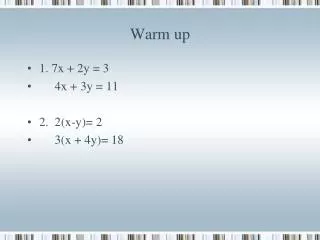
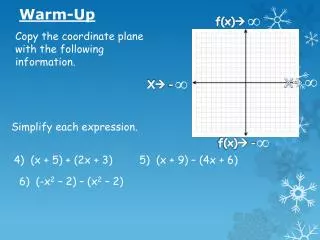
f(x) Warm-Up Copy the coordinate plane with the following information. X X - Simplify each expression. f(x) - 4) (x + 5) + (2x + 3) 5) (x + 9) – (4x + 6) 6) (-x2 – 2) – (x2 – 2)
An Intro to Polynomials Essential Questions: How can we identify, evaluate, add, and subtract polynomials? How can we classify polynomials, and describe their end behavior given the function?
Classification of a Polynomial by Degree n = 0 constant 3 linear n = 1 5x + 4 quadratic n = 2 2x2 + 3x - 2 cubic n = 3 5x3 + 3x2 – x + 9 quartic 3x4 – 2x3 + 8x2 – 6x + 5 n = 4 n = 5 -2x5 + 3x4 – x3 + 3x2 – 2x + 6 quintic
Classification of a Polynomial by Number of Terms monomial 3 binomial 5x + 4 trinomial 2x2 + 3x - 2 polynomial 5x3 + 3x2 – x + 9 -2x5 + 3x2– x5 - 3x2+ 6 binomial Combine like terms
Example 1a Classify each polynomial by degree and by number of terms. a) 5x + 2x3 – 2x2 cubic trinomial b) x5 – 4x3 – x5 + 3x2 + 4x3 quadratic monomial
Description of a Polynomial’s Graph f(x)= 3 f(x)= 5x + 4 f(x)= 2x2+ 3x - 2 f(x)= 5x3+ 3x2 – x + 9 f(x)= 3x4– 2x3 + 8x2 – 6x + 5 f(x)= -2x5 + 3x4 – x3 + 3x2 – 2x + 6
Example 1b Determine the polynomial’s shape and end behavior. a) f(x)= 5x + 2x3 – 2x2 b) f(x)= x5– 4x3 – x5 + 3x2 + 4x3
Example 2 Add (5x2 + 3x + 4) + (3x2 + 5) = 8x2 + 3x + 9
Example 3 Add (-3x4y3 + 6x3y3 – 6x2 + 5xy5 + 1) + (5x5 – 3x3y3 – 5xy5) -3x4y3 + 6x3y3 – 6x2 + 5xy5 + 1 5x5 - 3x3y3 - 5xy5 5x5 – 3x4y3 + 3x3y3 – 6x2 + 1
Example 4 Subtract. (2a4b + 5a3b2 – 4a2b3) – (4a4b + 2a3b2 – 4ab) 2a4b + 5a3b2 – 4a2b3 -4a4b - 2a3b2 + 4ab -2a4b + 3a3b2 – 4a2b3 + 4ab
Example 5 If the cubic function C(x) = 3x3 – 15x + 15 gives the cost of manufacturing x units (in thousands) of a product, what is the cost to manufacture 10,000 units of the product? C(x) = 3x3 – 15x + 15 C(10) = 3(10)3 – 15(10) + 15 C(10) = 3000 – 150 + 15 C(10) = 2865 $2865
Graphs of Polynomial Functions Graph each function below. 2 1 y = x2 + x - 2 3 2 y = 3x3 – 12x + 4 3 2 y = -2x3 + 4x2 + x - 2 4 3 y = x4 + 5x3 + 5x2 – x - 6 4 3 y = x4 + 2x3 – 5x2 – 6x Make a conjecture about the degree of a function and the # of “U-turns” in the graph.
Graphs of Polynomial Functions Graph each function below. 3 0 y = x3 3 0 y = x3 – 3x2 + 3x - 1 4 1 y = x4 Now make another conjecture about the degree of a function and the # of “U-turns” in the graph. The number of “U-turns” in a graph is less than or equal to one less than the degree of a polynomial.
Example 6 Graph each function. Describe its end behavior. a) P(x) = 2x3 - 1 b) Q(x) = -3x4 + 2