Understanding Propaganda Techniques: How Persuasion Shapes Opinions
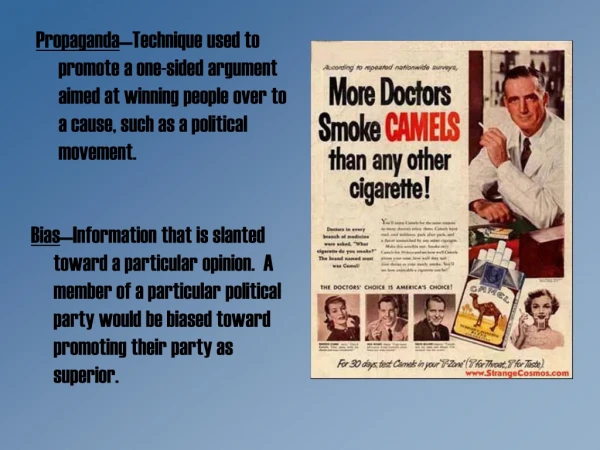
This text explores various propaganda techniques that influence public perception and behavior. Key strategies include transfer, which links unrelated ideas; bandwagon, pushing the notion of conformity; name-calling to evoke negative feelings; and card-stacking, which presents biased arguments by omitting counter-evidence. Other techniques involve the use of stereotypes, loaded words to elicit strong emotions, and emotional appeals that stir deep reactions. Understanding these methods is crucial for critically analyzing media and advertisements.

Understanding Propaganda Techniques: How Persuasion Shapes Opinions
E N D
Presentation Transcript
Transfer- Builds a connection between things that are not logically connected • Bandwagon- Encourages everyone to act because “everyone is doing it” • Name-calling- Labeling intended to arouse powerful negative feelings
Card-stacking- Purposefully presenting a bias by hiding or discrediting opposing arguments or evidence • Stereotypes- Presents a biased belief about a whole group based on insufficient or irrelevant evidence
Loaded words- Word choices meant to evoke or draw out strong positive or negative attitudes toward a person, group, or idea • Emotional appeals- Statements intended to arouse powerful emotional reactions
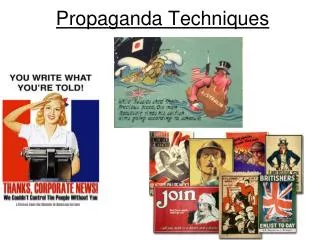
Advertisement Examples Through The Library of Congress: • http://memory.loc.gov/cgi-bin/query/r?ammem/rbpebib:@field(NUMBER+@band(rbpe+02301000)) • http://memory.loc.gov/cgi-bin/query/r?ammem/wpapos:@field(NUMBER+@band(cph+3b48885)) • ://memory.loc.gov/cgi-bin/query/r?ammem/eaa:@field(DOCID+@lit(eaa000309)) • http://memory.loc.gov/cgi-bin/query/r?ammem/wpapos:@field(NUMBER+@band(cph+3b48994)) http://memory.loc.gov/cgi-bin/query/r?ammem/papr:@field(NUMBER+@band(edmp+1353))