Download
1 / 13
140 likes | 264 Vues
This comprehensive guide explores essential measurement concepts in chemistry, focusing on unit conversions and understanding prefixes in the metric system. It covers key topics such as converting between ounces and gallons, inches and miles, and provides examples on how to measure volume, mass, and length accurately. The importance of units alongside numbers is emphasized, as well as the ease of using metric prefixes like kilo, centi, and milli. Learn to navigate conversions effectively and grasp the significance of using proper measurement units in scientific contexts.

E N D
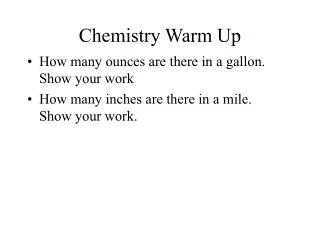
Chemistry Warm Up • How many ounces are there in a gallon.Show your work • How many inches are there in a mile.Show your work.
Measuring • Numbers are only half of a measurement. • Consider, “It is 10 long.” • 10 what? • Numbers without units are meaningless. • How many feet in a yard? • A mile? • A rod?
The Metric System • Easier to use - decimal system. • Every conversion is by some power of 10. • A metric unit has two parts. • A prefix and a base unit. • prefix tells you how many times to divide or multiply by 10.
Base Units • Length - meter - more than a yard - m • Mass - grams - about a raisin - g • Time - second - s • Temperature - Kelvin or ºCelsiusK or ºC • Energy - Joules- J • Volume- Liter - half of a two liter bottle- L • Amount of substance - mole - mol
Prefixes • kilo k 1000 times • deci d 1/10 • centi c 1/100 • milli m 1/1000 • micro μ1/1000000 • nano n 1/1000000000
Length • kilometer - about 0.6 miles • centimeter - less than half an inch • millimeter - the width of a paper clip wire
Volume • calculated by multiplying L x W x H • Liter the volume of a cube 1 dm (10 cm) on a side • 1L = 1 dm3 • so 1 L = 10 cm x 10 cm x 10 cm • 1 L = 1000 cm3 • 1/1000 L = 1 cm3 • 1 mL = 1 cm3
Volume • 1 L about 1/4 of a gallon - a quart • 1 mL is about 20 drops of water or 1 sugar cube
Mass • Weight is a force. Mass is the amount of matter. • 1 gram is defined as the mass of 1 cm3 of water at 4 ºC. • 1000 g = 1000 cm3 of water • 1 kg = 1 L of water
Mass • 1 kg = 2.5 lbs • 1 g = 1 paper clip • 1 mg = 10 grains of salt
k h D d c m Converting • how far you have to move on this chart, tells you how far, and which direction to move the decimal place. • The box is the base unit, meters, Liters, grams, etc.
k h D d c m Conversions • Change 5.6 m to millimeters • starts at the base unit and move three to the right. • move the decimal point three to the right 5 6 0 0
k h D d c m Conversions • convert 25 mg to grams • convert 0.45 km to mm • convert 35 mL to liters • It works because the math works, we are dividing or multiplying by 10 the correct number of times.