
Unveiling Igneous Rocks: Formation, Composition, and Uses
E N D
Presentation Transcript
Rocks Chapter 5 and 6
What are Igneous Rocks? Section 5.1
Types of Igneous Rocks • Igneous rocks are formed from the crystallization of magma • Igneous comes from Latin ignis which means fire • Lava is magma that flow out onto earth's surface
Types of Igneous Rocks Cont… • Extrusive igneous rocks are fine-grained igneous rocks that cool quickly on earth’s surface • Pumice or obsididan • Intrusive igneous rocks are coarse grained igneous rocks that cool slowly beneath the earth’s surface • Granite is the most common • Studies of granite formations reveal they cut across other formations, evidence of intrusion
Composition of Magma • Magmais a slushy mix of molten rock, gases and mineral crystals • Silica (SiO2) is the most abundant mineral in magma and has the greatest effect on magma characteristics
Magma Formation • Temperature, pressure, water content and mineral composition affect magma formation • Temperature and pressure increase with depth in the Earth’s crust • Pressure increases a rocks melting point • 1100 vs 1400
Magma Formation cont… • Rocks and minerals contain small percentages of water which decreases a rocks melting point • Minerals have different melting points • Rocks only melt at certain conditions • MUST have the right temperature, pressure, and mineral composition
How Rocks Melt • Rocks are made of different minerals • Minerals have different melting points so parts of a rock will melt at different times • Partial meltingis a process where some minerals melt at low temperatures while others stay solid
Fractional Crystallization • Just as minerals melt at different rates, they cool at different rates as well • Fractional crystallization is a process where minerals forma at different temperatures • The last minerals to melt are the first minerals to crystallize
Classifying Igneous Rocks Section 5.2
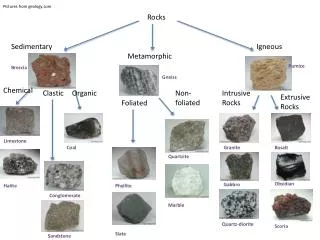
Mineral Composition • Three main groups of igneous rocks • Felsic, mafic, intermediate • Felsic rocks such as granite are: light colored, high silica contents, contain quartz and feldspars • Mafic rocks such as gabbro are dark colored, and rich in iron and magnesium
Grain Size • Igneous rocks differ in the size of their grains • Grain size is determined by the cooling rate • When lava cools quickly, small grains form • When lava cools slowly, large grains form
Igneous Rocks as Resources • Very useful for building materials because their interlocking grains make them strong • Also resistant to weathering • Granite is commonly used for building
Ore Deposits • Ores are minerals that contain a useful substance that can be mined at profit • Valuable ore deposits are often associated with igneous intrusions
Ore Deposits: Veins • Mineral rich magma fills the cracks and voids of surrounding rock • During magma crystallization, water, silica and any metals not common in minerals (gold, silver, lead, copper) are left over and eventually solidify to form veins
Ore Deposits: Pegmatites • Vein deposits main contain other valuable resources in addition to metals • Veins of extremely large grained minerals are called pegmatites • Rare elements and crystals are found in pegmatites
Ore Deposits: Kimberlites • Rare, ultramafic rocks that can contain diamonds or other minerals formed only under very high pressures
Formation of Sedimentary Rocks Section 6.1
Formation of Sedimentary Rocks • Sediments are pieces of solid material that have been deposited on Earth’s surface by wind, water, ice, gravity or chemical precipitation • When sediments become cemented together, they form sedimentary rocks
Weathering • Weathering is a set of physical and chemical processes that break rock down • Chemical weathering occurs when rocks are dissolved or chemically changed • Physical weathering occurs when rocks break off but remain chemically unchanged
Erosion and Transport • Erosion is the removal and movement of surface materials from location to another • 4 main agents: Wind, moving water, glaciers and gravity
Deposition • Deposition occurs when sediments are laid down on the ground or sink to the bottom of water • Sediments in water will create layers, with large particles settling first • Wind only moves fine sediments • Glaciers and landslides move all sediments equally
Burial • Most sediments are deposited in basins where the building layers increase pressure and temperature • Increasing pressure and temperature cause lithification, or the chemical and physical processes that transform sediments into sedimentary rocks
Lithification • Lithification begins with compaction • The weight of overlying sediments force sediments together • The temperature in earth's crust are high enough to cause cementation • Cementation occurs when mineral growth cements sediments together into solid rock
Lithification cont… • Two types of cementation • New minerals can grow between sediment grains • The same mineral grows between the sediment grains
Features of Sedimentary Rocks • The primary feature of sedimentary rocks is horizontal layering called bedding • Bedding with particle sizes that become heavier at the bottom is called graded bedding • Cross-bedding is another type of bedding where layers of inclined sediment move forward across a horizontal surface
Metamorphic Rocks Section 6.3
Causes of Metamorphism • Meta means change and morphe means forms • During metamorphism, rocks change form while remaining solid • Pressure and temperature increase with depth • Temperature comes from earths internal heat • Pressure comes from overlying rocks or compression during mountain building
Types of Metamorphism • When high temperature and pressure affect large regions of crust, they produce large belts of regional metamorphism • When molten rock come into contact with solid rock, a local effect called contact metamorphism occurs • When very hot water reacts with rocks and alters its chemistry and mineralogy, hydrothermal metamorphism occurs • Occurs near igneous intrusions and active volcanoes
Metamorphic Textures • Metamorphic rocks have two textural groups: foliated and nonfoliated • Wavy layers and bands of minerals of flat crystals characterize foliated metamorphic rocks • Schist from shale (clay) and gneiss from granite If I said you were gneiss, I’d be for of schist! lol
Metamorphic Textures Cont… • Nonfoliated rocks lack mineral grains with flat crystals and instead have blocky crystal shapes • Quartzite from quartz-rich sandstone and marble from limestone
The Rock Cycle • The continuous changing and remaking of rocks is called the rock cycle • Igneous rocks crystalize from magma • Sediments cement together to form sedimentary • Pressure and temperature form metamorphic rock • All rocks can change into one another!