Understanding Redox Half Reactions: Balancing Oxidation and Reduction Steps
This comprehensive guide explores the oxidation and reduction half-reactions in redox chemistry. It begins with a review of the properties and variations of phosphorus colors related to its atomic structures. The focus then shifts to identifying and balancing redox half-reactions, using examples like zinc and cobalt reactions. Step-by-step instructions are provided for finding oxidation states, writing half-reactions, and balancing charges. Practice problems reinforce understanding. Ideal for students seeking to grasp essential redox concepts.

Understanding Redox Half Reactions: Balancing Oxidation and Reduction Steps
E N D
Presentation Transcript
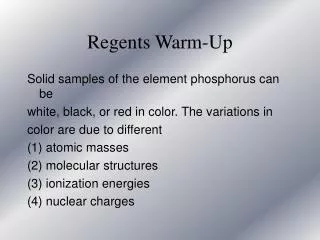
Regents Warm-Up Solid samples of the element phosphorus can be white, black, or red in color. The variations in color are due to different (1) atomic masses (2) molecular structures (3) ionization energies (4) nuclear charges
AIM: How do we identify oxidation/reduction half reactions? DO NOW: What is the oxidation number of chromium in the chromate ion, CrO42–? (1) +6 (3) +3 (2) +2 (4) +8 Redox Half Reactions
Redox Half Reactions Example – for the reaction Zn0(s) + Co+3(aq) Zn+2(aq) + Co0(s) • Identify, write and balance the oxidation half reaction. • Identify, write and balance the reduction half reaction. • Balance the electrons that are transferred.
ID Oxidation Half Rxn • The oxidation: STEP ONE: find the species whose oxidation state INCREASES across the arrow. In this case it is the zinc. STEP TWO: write the species as a half reaction, check to balance mass ( equal number of each element on each side); Zn0(s) Zn+2(aq) STEP THREE: add electrons to the more positive side to balance charge Zn0(s) Zn+2(aq) + 2e- Here you add 2e- to the right cancel the 2+ to 0.
ID Reduction Half Rxn 2. The reduction: STEPS ONE: find the species whose oxidation state DECREASES across the arrow. In this case it is the cobalt. STEP TWO: write the species as a half reaction, check to balance mass ( equal number of each element on each side); Co3+(s) Co0(aq) STEP THREE: add electrons to the more positive side to balance charge 3e- + Co3+(s) Co0(aq) Here you add 3e- to the left cancel the 3+ to 0.
Balancing Half Rxns • Balance the electrons released from the oxidation with the electrons consumed in the reduction, make them equal Zn0(s) Zn+2(aq) + 2e-oxidation releases 2 mol of e- 3e- + Co3+(s) Co0(aq) reduction consumes 3 mol of e-
Balancing Half Rxns • In this example, 2 and 3 are factors of 6, therefore multiply the entire oxidation by 3, and the entire reduction by 2 such that each half reaction has 6 electrons. 6 is the LCM here. 3 Zn0(s) 3 Zn+2(aq) + 6e- 6e- + 2 Co3+(s) 2 Co0(aq) • the electrons now cancel across the arrow and the half reactions can be added.
Balancing Half Reactions The total overall rxn is: 3 Zn0(s) 3 Zn+2(aq) + 6e- 6e- + 2 Co3+(s) 2 Co0(aq) _______________________________ 3Zn0(s) + 2 Co3+(s) 2 Co0(aq) + 3 Zn+2(aq)
Practice a. PCl3 + Cl2 → PCl5 b. Cu + 2AgNO3 →Cu(NO3)2 + 2Ag c. CO2 + 2LiOH → Li2CO3 + H2O d. FeCl2 + 2NaOH → Fe(OH)2 + 2NaCl e. MnO2 + 4HCl → Cl2 + 2H2O + MnCl2