The Evolution of Buddhism During the Kamakura Period in Japan (1192-1333)
The Kamakura period (1192-1333) was a transformative era for Buddhism in Japan. Notable figures such as Shunjo, Eisai, and Dogen played pivotal roles in introducing and establishing various schools of Zen and Chan Buddhism. Shunjo returned from China in 1211, founding Sennuji in Kyoto, while Eisai introduced Zen to the city in 1202, establishing Keninji. Dogen spent years in China before returning in 1227, influencing Japanese spirituality significantly. This period also saw a flow of Chinese masters to Japan, further enriching its Buddhist traditions.

The Evolution of Buddhism During the Kamakura Period in Japan (1192-1333)
E N D
Presentation Transcript
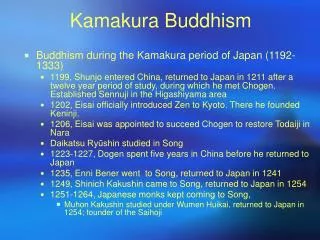
Kamakura Buddhism • Buddhism during the Kamakura period of Japan (1192-1333) • 1199, Shunjo entered China, returned to Japan in 1211 after a twelve year period of study, during which he met Chogen. Established Sennuji in the Higashiyama area • 1202, Eisai officially introduced Zen to Kyoto. There he founded Keninji. • 1206, Eisai was appointed to succeed Chogen to restore Todaiji in Nara • Daikatsu Ryūshinstudied in Song • 1223-1227, Dogen spent five years in China before he returned to Japan • 1235, Enni Benerwent to Song, returned to Japan in 1241 • 1249, Shinich Kakushincame to Song, returned to Japan in 1254 • 1251-1264, Japanese monks kept coming to Song, • Muhon Kakushin studied under Wumen Huikai, returned to Japan in 1254; founder of the Saihoji
Chinese Chan Masters in Japan • Kamakura government invited Chinese Chan masters • Enmitsuzenkai, rather than pure Chan, had been practiced in Japan • Chinese Chan masters came to Japan, invited by individual or by government • 1246, Lanxi Daolong (Ranki Doryo) arrived in Japan and teach at the Jorakuji • 1260, Wuan Puning (Gottan Funei) arrived in Japan • 1270, Daxiu Zhengnian (Daikju Shonen) arrived in Japan, later became the founder of Jochiji