Exploring Traits in Personality Psychology
Discover the history, models, and judgments of personality traits. Analyze Big Five traits, types, motives, and expressive styles. Learn the relationships and implications within trait aspects of personality.

Exploring Traits in Personality Psychology
E N D
Presentation Transcript
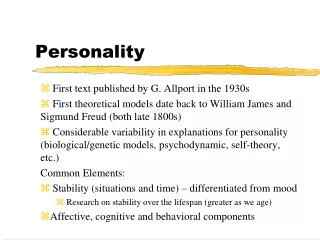
Personality Sixth edition Chapter 8 Trait Aspects of Personality
Modules Introduction: Trait Aspects of Personality 8.1: The History of Trait Approaches 8.2: Gordon Allport’s Trait Psychology 8.3: The Big Five 8.4: Personality Judgments 8.5: Types 8.6: Motives 8.7: Expressive Style Conclusion: Trait Aspects of Personality
Learning Objectives (1 of 2) 8.1: Evaluate the development of different approaches to analyzing traits 8.2: Analyze the claims made by Gordon Allport’s trait psychology 8.3: Examine the five dimensions of the most common trait approaches to personality 8.4: Examine how people judge the personalities of other people
Learning Objectives (1 of 2) 8.5: Review the concept of personality types 8.6: Use the concept of motive to understand personality 8.7: Scrutinize the relationship between personality and expressive style
Introduction: Trait Aspects of Personality? • Different approaches to analyzing traits • Five dimensions of most common trait approaches to personality
8.1: The History of Trait Approaches Traits for characters in stories Greek contribution Modern approaches Objective: Evaluate the development of different approaches to analyzing traits
8.1.1: Jung’s Extroversion and Introversion • Trait approaches • Myers-Brigg Type Indicator
8.1.2: The Use of Statistics • Factor analysis • Cattell’s approach
8.1.3: Q-data,T-data, L-data, and the 16PF • Q-data • T-data • L-data
8.2: Gordon Allport’s Trait Psychology Allport’s first meeting with Freud Allport’s approach Objective: Analyze the claims made by Gordon Allport’s trait psychology
8.2.1: The Importance of Culture • Studying prejudice • Studying cultural influences on personality
8.2.2: Functional Equivalence • Drawbacks of factor analysis • Allport’s solution
8.2.3: Common Traits • Common biological heritage • Childhood experiences
8.2.4: Personal Dispositions • Idiographic methods • Nuclear quality • What is personal disposition?
8.3: The Big Five Extroversion Agreeableness Conscientiousness Neuroticism Openness Objective: Examine the five dimensions of the most common trait approaches to personality
8.3.1: How Was the Big Five Model Developed? • Overview • Factor analysis
8.3.2: Career Pathways and Other Important Outcomes • Extroverts • Conscientiousness • Agreeableness • Entrepreneurs
8.3.3: More Than Five? Fewer Than Five? • Derived from new knowledge • Cattell’s scheme
8.3.4: Eysenck’s Big Three and Related Alternatives • Hans Eysenck • Eysenck’s theory
8.3.5: Evidence for Eysenck’s Approach • Study: Zuckerman, Joireman, Kraft, & Kuhlman, 1999 • Point 2: Study: Wilt & Revelle, 2009 • Point 3: Study: Lucas & Diener, 2001 • Point 4: Study: Canli, 2006; Canli et al., 2001
8.4: Personality Judgments Love at first sight Implications Objective: Examine how people judge the personalities of other people
8.4.1: Consensus in Personality Judgments • Strangers making judgments • Self-rating • Peers and friends making judgments
8.4.2: Limits of Trait Conceptions • Other aspects that affect • Are professionals better?
8.5: Types Different types of personality Type theories Objective: Review the concept of personality types
8.6: Motives What are motives? Types of needs Objective: Use the concept of motive to understand personality
8.6.1: Measuring Motivation • Using self-report tests • For unknown needs
8.6.2: Motivational Approach to Traits • Need for achievement • Need for affiliation • Need for power • Need for exhibition
8.7: Expressive Style Expressive style elements of cartoon characters Consistency in human characteristics Objective: Scrutinize the relationship between personality and expressive style
8.7.1: Emotional Expressiveness • Relationship of expressive style to personality • Overall expressiveness
8.7.2: Dominance, Leadership, Influence • Dominant people • Expressive people
8.7.3: Expressiveness and Health • Healthy personality • Unhealthy personality • Studying nonverbal social skill
Conclusion: Trait Aspects of Personality • Advantages • Limitations • Common assessment techniques • Implications for therapy