Understanding Graphs: Independent and Dependent Variables in Data Representation
This guide provides an overview of graphing concepts, focusing on independent variables (IV) and dependent variables (DV). It explains their roles in experimental design and data analysis, illustrating how the IV is manipulated (e.g., speed of a car) and the DV relies on it (e.g., time taken). Key types of graphs, including scatter plots, line graphs, bar graphs, and pie charts are covered. The importance of interpolation and extrapolation in data analysis is also discussed, equipping learners with the foundational skills needed for effective data representation.

Understanding Graphs: Independent and Dependent Variables in Data Representation
E N D
Presentation Transcript
Y axis X axis
IV vs. DV Independent variable (IV): Manipulated variable Ex: speed Dependent variable (DV): Relies on the manipulated variable Ex: time
DRY MIX Dependentvariable Relieson manipulated Y axis Manipulated variable Independentvariable X axis
Title DV 70 DV vs. IV 60 50 DV (with units) 40 SCALE LABELS 30 20 10 IV 1st 2nd 3rd IV (with units)
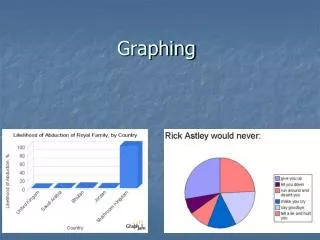
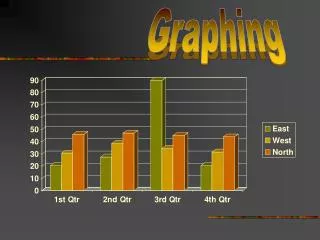
TYPES OF GRAPHS • Scatter plot: we use this 95% of the time (best fit line) • Line graph: shows changes over time or space • Bar graph: compares different variables • Pie graph: useful with percentages
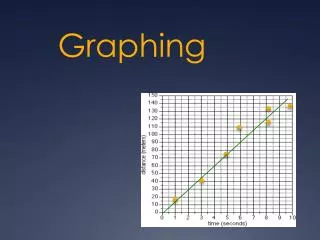
Speed of A Car TIME (s) DISTANCE (m)
Volume vs. Temp. TEMP ( OC) VOLUME (mL)
KI SOLUBILITY GRAMS DISSOLVED TEMP ( OC)
Abundance of Elements in the Lithosphere Elements %
Interpolate vs. Extrapolate • Interpolate: being able to “construct” data points from inside a known data set • Extrapolate: being able to “construct” data points from outside a known data set (predict)
Interpolate: Distance at time 2.5 s = Extrapolate: Time at Distance 15 m = 5m 9 s X s 6 s = 15 m 10m X s = 0.6 15 m
Create the data table! • For the next slides you will create a data table representing the given graph • Be sure to label IV and DV!
Frozen Dessert Production Frozen dessert Gallon (mil)
USE THE DATA AT THE RED DOTS Individual Water Use from 1983-2001 Water Use (Liters per person) Municipal Water Use Per Person from 1983-2001 Year L / person
Sources of Radiation Exposure sources %