
Franklin D. Roosevelt's New Deal: A Comprehensive Relief & Recovery Effort
E N D
Presentation Transcript
The New Deal Relief & Recovery Chapter 13
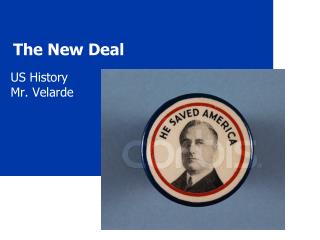
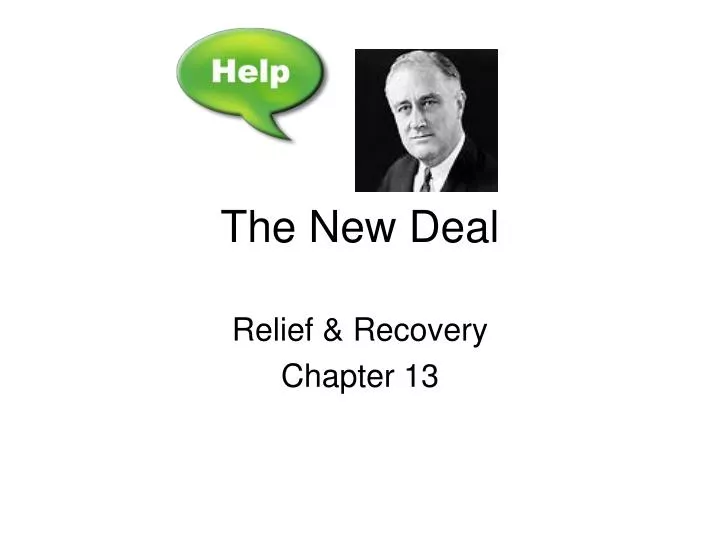
Franklin D. Roosevelt • Election of 1932 • Herbert Hoover, Republican • Franklin D. Roosevelt, Democrat • FDR wins by landslide • Largest victory over Republicans ever • Previously Gov. of New York • Campaigned for the “forgotten man” at bottom of society • Married to Eleanor Roosevelt • Cousin of Teddy Roosevelt
FDR • Unknown to most America, FDR suffered from polio as child; left partially paralyzed • Kept secret from Americans so they would believe they had “strong” leader • Used wheelchair (when away from public) • No TV time, he only used radio • Physical challenges no problem on radio
1st 100 Days • Used “Fireside Chats**” to keep Americans informed on plans/progress made • **used radio as tool to communicate with masses • Promised “Bold, persistent experimentation” that could solve problems. • Began dealing with major issues immediately.
New Deal • First official job: • Evaluate banking crisis • 1933, over 6,000 banks failed • 9 million people lost life savings • 3 goals: • Relief for suffering Americans • Recovery of the depressed economy • Reforms to prevent future economic problems
Banking Crisis - 1 • March 5 • Ordered all banks closed for “bank holiday” • Emergency Banking Act • Law that gave $$$ to stronger banks • Reorganized the weak banks • Reopened banks March 13 • Federal Deposit Insurance Corporation- 1933 • Insurance against losing $$$ in bank accounts (up to $5,000.00) Glass-Steagall Act • To give Americans secure feeling-$$$ in the bank
Securities Act • Regulate sale of stocks • Created the Securities and Exchange Commission • Job to watch over stock sales
Housing - 2 • Home Owner’s Loan Act • Created the Fair Credit Administration • Agency designed to watch over all home loans • Prevent deceptive loans • To prevent high default rate on home loans • Home Owner’s Loan Corporation • Made $$$ available to allow refinancing of “bad” home loans • First federal mortgage guarantee program • To prevent foreclosures
Employment-3 • Federal Emergency Relief Administration • Put $500 million into state-run welfare programs • Which gave cash to people • Lasted until 1935 • Created “ABC” work programs • Civil Works Program • Employed teachers, laborers & professionals
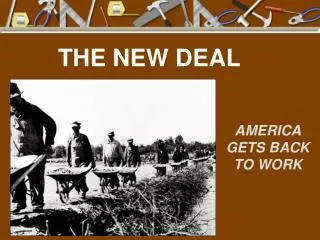
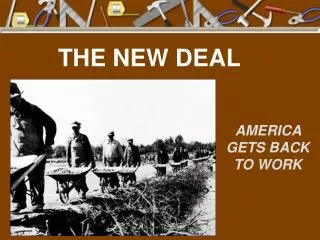
“ABC” Employment • 1. PWA (Public Works Administration) • Worked on public properties (bridges, roads) • 2. CCC (Civilian Conservation Corps) • Young single men who worked outdoors • Flood control projects & replanted forests
Agriculture - 4 • AAA (Agricultural Adjustment Admin.) • Paid farmers not to plant – Subsidy • Plowed under +10 million acres of cotton – stabilize prices • Killed + 9 million pigs/cattle-price fixing
Labor Relations - 5 • National Industrial Recovery Act • Suspended all anti-trust laws • Set quotas for production • Established price controls • Set wages & working conditions for workers • Guaranteed rights to collective bargaining (negotiation for better $$$)
Public Projects - 6 Tennessee Valley Authority (TVA) May 1933 develop natural resources provide hydro-electric power for industries Civil Works Administration +jobs for 4 million workers built +1,000 miles of highways, sewer line & airports
Native Americans - 7 • Indian Reorganization Act • Reversed all previous Indian policies • Limited the sale of tribal lands • Gave assistance to Natives • Develop their resources • Build economies • Save cultures
Critics of New Deal • Said New Deal too expensive • Government had “no business” interfering in people’s lives • Feared a welfare state (people would feel entitled to federal $$$) • Feared people would become lazy • “waiting on the government check”
Critics pt. 2 • Father Charles Coughlin • Catholic priest • Took anti-FDR and anti-Jew speech to radio • He said Roosevelt had “out-Hoovered Hoover” • Called the New Deal the “Raw Deal” • 1942, indicted for his personal attacks on FDR • Censored (ordered to stop by Bishop)
Critics pt. 3 • Sen. Huey P. Long • Louisiana (against FDR’s policy of government assistance to people) • He proposed a “wealth redistribution” • (take from wealthy, give to poor) • Guarantee all poor people $2,000 year • Limit families earning no more than $1 million year (extra $$ go to government) • 1935 shot by political enemy
Second New Deal • 1935 FDR re-elected on “wanting a country in which no one feels left out” • He said he saw 1/3 of the nation ill-housed, ill-clad, and ill –fed. • He believed entitlement programs were okay because US citizens were entitled to receive them due to payments of payroll taxes. • He began expansion of 1st New Deal programs to stop those identified problems.
2nd New Deal – Employment • WPA 1935 • Declared discrimination illegal in federal WPA jobs • Gave jobs +9 million people • Built schools • Roads/bridges • Libraries • National Youth Administration • Hired kids part-time to help family
Personnel Changes • 1935 FDR includes “minority” members to cabinet • Francis Perkins (1st female) • Sect. of Labor • Ruth Bryan Owen (1st female) • Ambassador – Denmark • William Hastie (1st black) • Federal Judge • Mary McLeod Bethune (1st black female) • Dir. Of Negro Affairs
Social Security Act • 1935 (4 goals) “Entitlement Program” • Provide unemployment insurance • Old-age pension • Aid to single mothers and widows • Aid to the blind • Problems: • Did not apply to farmers or domestic workers • Most blacks were not eligible
Farm Help • 1935 Rural Electric Administration (REA) • Beginning of depression, only 10% farmers had electricity • REA loaned $$ to electric companies to build lines to rural area • By 1950, over 80% of Americans had electricity
Labor Issues • 1936 Wagner Act (National Labor Relations Act) • Outlawed unfair anti-labor practices • Established new national labor board • Given authority to conduct elections to unionize or not • Employers had no control and had to accept results of elections by membership
Labor pt. 2 • American Federation of Labor (AFL) • Created a collection of smaller unions into larger unit • Represented interests of skilled workers and became largest union of nation • Looked down on unskilled worker (immigrants) • Would join CIO to create • Largest union ever
Labor, pt. 3 • Congress of Industrial Organization (CIO) • John Lewis • Group for unskilled workers (Immigrants) • Started as the United Mine Workers • Changed name to include other job descriptions
GM Sit-Down Strike • Flint, Michigan: December 1936 • Newly formed United Auto Workers (UAW) • Staged “sit-down” strike (went to job, refused to work) • GM sent police to threaten to move them • Stayed in plant 24/7 • Supporters brought food in • Sent message to Governor “not gonna leave”
End Strike???? • GM tried “traditional” strike breaking methods: • Brought security in to scatter workers • Hired non-union people to come in & work • Too dangerous to take factory • Damage to factory high $$$ • Negative publicity for hurting/killing workers • DID NOT WORK
End Strike??? Pt. 2 • Finally, used these methods: • Asked Michigan state police to remove workers • Shut off heat & water to factory • Stopped people from delivering food & supplies to the workers • Led to riot; strikers fought & defeat the police • End Result: • GM lost tens of millions; strike lasted 44 days • Forced to give in to workers & recognize union
Judicial Actions • Supreme Court opposed the New Deal • Ruled 2 of FDR programs Unconstitutional and therefore, illegal: • National Industrial Recovery Act • Agricultural Adjustment Act • FDR saw the Court as a threat to national recovery; devised a plan to weaken the court and to restructure it…
Court-Packing Plan • FDR proposed adding up to 6 new judge positions; those who would be “friendly” toward him. • Supreme Court realized FDR not their friend; he would reduce their power. • Supreme Court began to work with FDR; court packing not now necessary; did not happen.
“Roosevelt’s Recession” • 1937: economy turns for worse • Unemployment at 20% • Banks reduced lending $$$ • Growing deficit (spend more than you bring in) • New employment programs needed • Proposed Keynesian economics • Deficit spending could provide jobs/stimulate economy
1937-1938 • 10 million workers lost jobs • People believed FDR alienated business • Some reform programs doing well: • FDIC: helped restore faith in banks • SEC: created public support for stock market • WPA: built many bridges & buildings still stand today • New Deal: credited with bringing Americans in touch with government
Fair Labor Standards Act • 1938-had many benefits: • Set the minimum wage law • Set the maximum hours for work days • Set the work week at 44 hours • Overtime had to be paid time +1/2 • FSLA would be 1 of FDR’s lasting testimonials of his presidency. • Helps him win re-election in 1938.
1930’s Culture • Government actively encourage & $$ supported the arts and culture (1st time) • Wizard of Oz, 1939 • Escapism • People sought relief from “real life” • For short time, Americans could think of something else other than depression.
Culture, pt 2 • Federal Art Project • Special branch of WPA • Provided jobs for artists • Federal Writer’s Project • Federal Theatre Project • Dorothea Lange • Worked for the Resettlement and Farm Security Admin. • Job was to take pics of poor & deposed farmers • Most famous “migrant mother” picture
Lange pics • Dorothea Lange Migrant Mother
“Free time” • Monopoly, 1935 • Created, popular game to escape with • 3 Little Pigs • Cartoon story • Wolf – Depression • Pigs – average citizens who feared the depression • Gone With The Wind • King Kong