Histograms
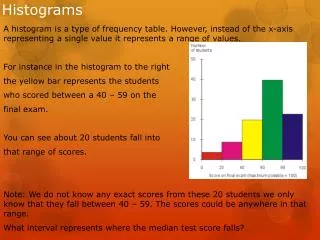
This guide covers the essentials of histograms in data visualization. It details how to plot and read data using height and width calculations. Important formulas illustrate the relationship between area, width, height, and frequency. For instance, to find the frequency of individuals aged 70 to 120 in Lalatown, you calculate the width (120 - 70 = 50) and height (frequency density = 10), leading to a total frequency of 500. This concise explanation will empower you to effectively interpret histograms and glean insights from your data.

Histograms
E N D
Presentation Transcript
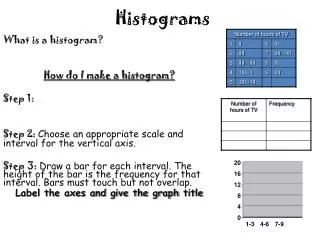
Histograms Part A – Plotting Part B - Reading
Part A- Plotting • Random set of data
Important Formula • Height = Frequency / Width • H = F / W • W * H = F • F = W * H • Area = W * H • Therefore, • Area = Frequency • Note : Width refers to the range
How to read? • Since W * H = F = Area • You take the width of the bar and multiply it by the width to get the frequency. • Eg. From the histogram, find the frequency of people aged 70 ≤ y<120 in Lalatown. • 120 – 70 = 50 (width) • Height = 10 (Frequency Density) • 50 * 10 = 500 • Therefore, the frequency of people aged 70 ≤ y<120 in Lalatownis 500.