Understanding Fascism and Totalitarianism During World War II
140 likes | 266 Vues
This brief overview defines key terminology related to World War II, focusing on fascism as a totalitarian government model characterized by dictatorial power, nationalism, and socioeconomic control. It explores concepts like internment, genocide, and anti-Semitism in the context of the Holocaust, highlighting the systematic mass execution of Jews and other targeted groups. Additionally, it touches on military strategies such as Blitzkrieg and the post-war superpowers. This vocabulary is essential for understanding the political landscape and human rights violations of this tumultuous period.


Understanding Fascism and Totalitarianism During World War II
E N D
Presentation Transcript
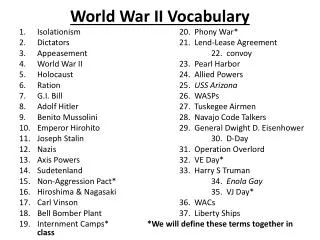
fascism a totalitarian government that glorifies one race, one nation and war; characterized by a strong dictator; socioeconomic control; and, suppressionof opposition
dictator one person who has total control of a country
nationalism strong feeling of loyalty and pride in one’s country; super-patriotism
appeasement to give in to someone who is threatening to fight in order to keep the peace
internment to confine and watch a group of people for the protection of society, especially in wartime
genocide attempting to or eliminating an entire race of people
anti-semitic strong dislike of Jewish people
Holocaust systematic mass execution of millions of people during WWII by the Nazis
selective service military draft
rationing Controlling the amount of something (i.e. sugar; gasoline; plastic)
embargo Not allowing a shipment of goods into or out of a nation’s ports
Blitzkrieg Lightening warfare; German military strategy during WWII
superpowers U.S. and Soviet Union after WWII