Download
1 / 18
190 likes | 347 Vues
This document presents a thorough exploration of transfer functions in linear systems, authored by Eng. R.L. Nkumbwa from Copperbelt University in 2010. It defines the transfer function, G(s), which showcases the input-output relationship of a system in the s-domain. The text discusses the importance of taking the Laplace transform of state and output equations, as well as the concepts of poles and zeros in transfer function analysis. Key relationships between the numerator and denominator polynomials are established, including realization conditions.

E N D
Concept of Transfer Function Eng. R. L. Nkumbwa Copperbelt University 2010
Personal Eng. R. L. Nkumbwa @ CBU 2010
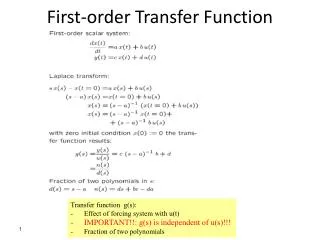
Concept • Consider a single input, single output linear system: Eng. R. L. Nkumbwa @ CBU 2010
Where, • A is an n-by-n matrix, b is a n-by-one vector, c is a one-by-n vector, and d is a scalar. • Taking the Laplace transform of the state and output equations, we get: Eng. R. L. Nkumbwa @ CBU 2010
We get Eng. R. L. Nkumbwa @ CBU 2010
Let x0 = 0. We are interested in finding the input-output relation, which is the relation between Y(s) and U(s). Eng. R. L. Nkumbwa @ CBU 2010
Transfer Function • G(s) is called the transfer function, and represents the input-output relation for a given system in the s-domain. • The above equation is an important formula, but note that it may not necessarily be the easiest way to obtain the transfer function from the state and output equations. Eng. R. L. Nkumbwa @ CBU 2010
Transfer Function Definition • The transfer function is sometimes defined as: • The Laplace transform of the time impulse response with zero initial conditions. • The development directly above is where this definition comes from. Eng. R. L. Nkumbwa @ CBU 2010
In Time Domain Eng. R. L. Nkumbwa @ CBU 2010
In Laplace Domain Convolution in the time domain = Product in the Laplace domain. Eng. R. L. Nkumbwa @ CBU 2010
Notion of Poles and Zeros • In the above, the transfer function G(s) was found to be a fraction of two polynomials in s. Eng. R. L. Nkumbwa @ CBU 2010
The denominator, D(s), comes from the determinant of (sI-A), which appears from taking the inverse of (sI-A). Eng. R. L. Nkumbwa @ CBU 2010
Values of “s” • These values of s have the same importance in the present discussion. • Values of s that make the numerator, N(s), go to zero are called zeros since they make G(s) = 0. Values of s that make the denominator, D(s), go to zero are called poles; they make G(s) = ¥. Eng. R. L. Nkumbwa @ CBU 2010
Transfer Function Analysis Eng. R. L. Nkumbwa @ CBU 2010
Alternatively put, • The poles are the roots of D(s), and the zeroes are the roots of N(s). Eng. R. L. Nkumbwa @ CBU 2010
Realization condition • The realization condition states that the order of the numerator is always less than or equal to the order of the denominator. Eng. R. L. Nkumbwa @ CBU 2010
Wrap-Up Eng. R. L. Nkumbwa @ CBU 2010