Understanding Reapportionment, Redistricting, and the Impact of Gerrymandering on Local Politics
230 likes | 364 Vues
This overview explores the vital processes of reapportionment and redistricting in the context of US political geography. It delves into contentious practices like gerrymandering, which manipulates district boundaries to consolidate power or dilute opposition. The discussion includes key compromises (e.g., Virginia vs. New Jersey Plan, 3/5 Compromise) and highlights the significance of representation based on population changes. With references to local governance and the challenges of equitable representation, this examination reveals how these political processes shape democracy and influence voter choice.


Understanding Reapportionment, Redistricting, and the Impact of Gerrymandering on Local Politics
E N D
Presentation Transcript
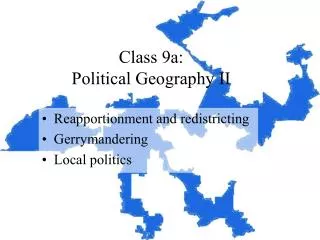
Class 9a: Political Geography II • Reapportionment and redistricting • Gerrymandering • Local politics
Proportional representation • VA Plan vs. NJ Plan Great Compromise • Large states wanted proportional repr. • Small states wanted equal repr. • 3/5 Compromise on slaves
Proportional representation • 100 Senators, 435 Representatives • Basis for Electoral College • All votes are not equal • Minimum representation • Winner-take-all
Reapportionment • Population changes with migration • Need to reapportion seats • Based on Census • Every state keeps at least one Representative • Method of equal proportions
Redistricting • Redrawing district boundaries based on reapportionment • In most states, done by legislature • Meant to maintain equality of votes • Can be manipulated
Gerrymandering • Discriminatory redistricting • Consolidating power • Diluting opponents’ power
Gerrymandering • Racist gerrymandering after Civil War • Put all minorities in one district • Dilute them among all districts • 1982 Voting Rights Act • Majority-minority districts • Constitutional issues
IL: 4th District TX: 12th District FL: 22nd and 23rd Districts GA: 13th District NY: 18th District
Gerrymandering and democracy • Preserves incumbents • In 1992, 61% of races won by >20% • In 2002, 80% of races won by > 20%; average margin of victory 39% • 1 of 53 seats in CA competitive
Gerrymandering and democracy • Removes decision-making from voters • “Candidates choose the voters” • More polarized Congress
Local politics • Hierarchy of jurisdictions • Special-purpose districts • Local governments and urban sprawl
Hierarchy of jurisdictions • First order divisions • Largest units within a state • Provinces, states, oblasts, prefectures • Unitary vs. federal
Hierarchy of jurisdictions • Second order divisions • Counties, townships, parishes, boroughs • 3000 in US; from 24 to 20,000 miles2 and from 100 to 8 million residents • Functions depend on the state • Law enforcement, highways, taxes, statistics, welfare, elections
Hierarchy of jurisdictions • Minor civil divisions • Townships, cities, villages • Land use and zoning • Growth by annexation
Special purpose districts • Consequence of federal system • Territory and organization for one purpose • Fire, water, flood control, mosquito control, irrigation, etc. • Over 35,000 in 2002
School districts • Land granted to new territories (1 section per township) • Land grant colleges • Historically, little federal input • Over 15,000 in 2002 • Funding depends on local tax income
Urban sprawl • Too much local decision-making • Each MCD acts in its own interests • Maximize tax revenue • Minimize need for services • Reluctance for regional government